
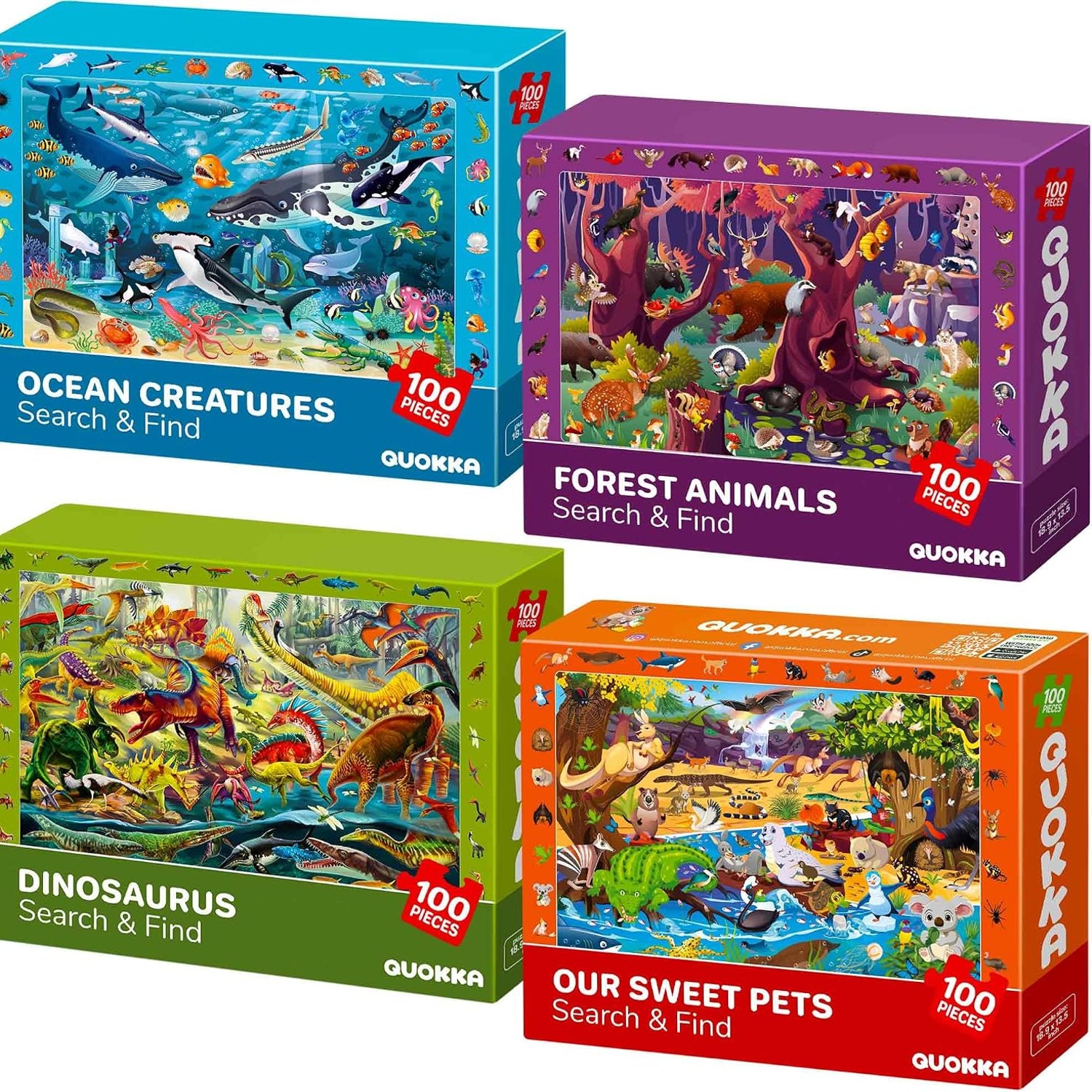

The complete guide
Choosing a 100 Piece Puzzles 4 Pack, A Practical Buyer's Guide
The gap nobody warns you about
There is a strange dead zone in children's puzzles. At three or four, a child is doing chunky 24-piece boards with fat pieces and a picture of a tractor. By ten, if they are still interested, they have moved on to 300 or 500 pieces and can hold their own at the family table. The years in between are where most children quietly stop doing puzzles altogether.
The reason is usually mismatch. The 24-piece board is finished in four minutes and feels babyish. The 300-piece box gets opened, the pieces go everywhere, and after twenty minutes of finding nothing the child goes to look at a screen instead. Neither experience makes them want to do another puzzle.
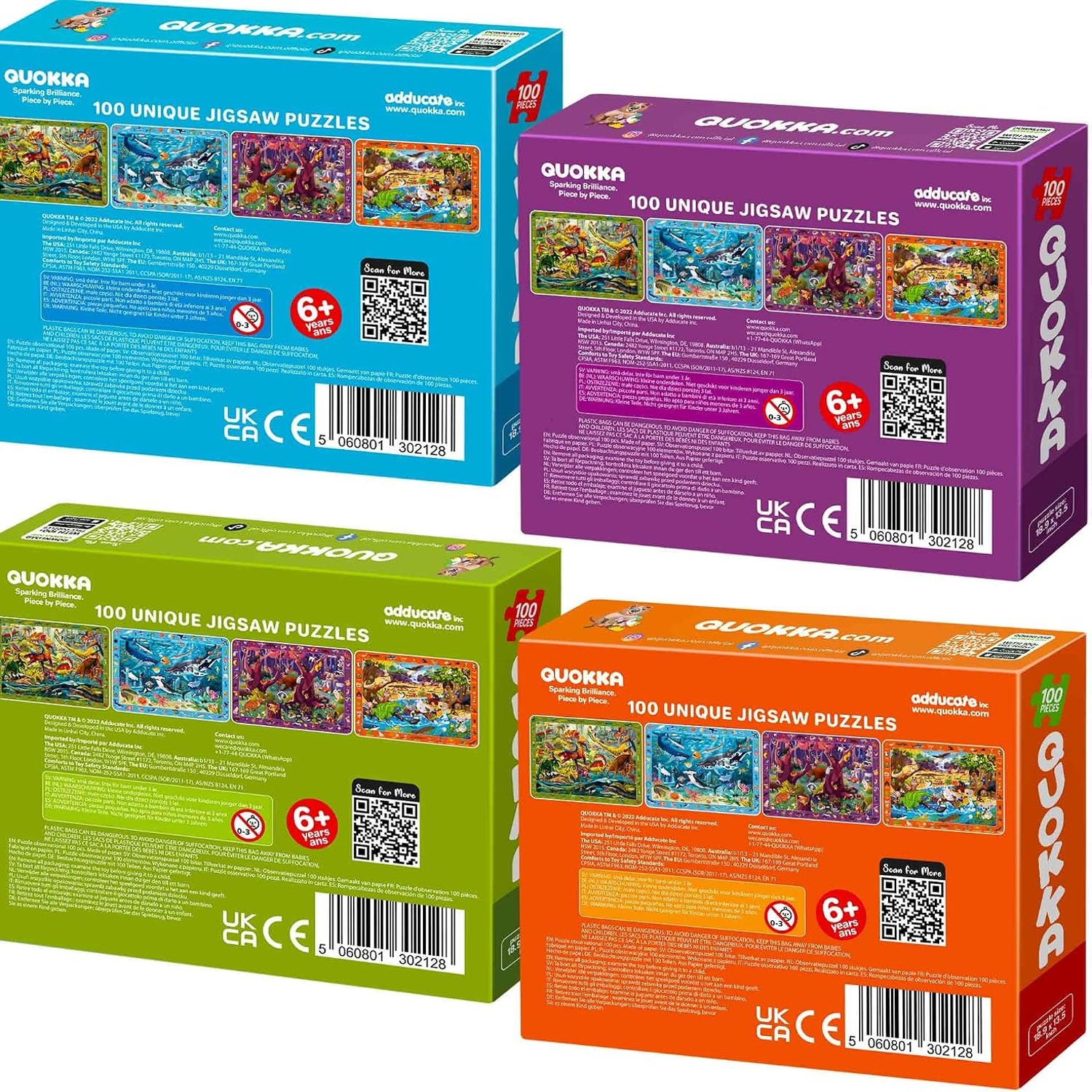
One hundred pieces is the step that works. It takes real effort, maybe half an hour to an hour depending on the child, which is long enough to feel like an achievement. But the pieces are still large enough to handle, and the picture comes together fast enough to keep interest alive. This QUOKKA set gives you four of them, which matters because one puzzle only ever tells you half the story.
Why four puzzles beats one
The second puzzle is where the learning actually sticks. On the first one, a child is mostly following instructions, finding corners because you told them to find corners. On the second they start doing it unprompted. By the third they have a method.
A four-pack also solves two practical problems. The first is siblings. One puzzle and two children usually ends in negotiation, and not the productive kind. Four boxes means everyone gets their own and nobody has to take turns. The second problem is novelty. A single puzzle is finished, admired for a day, then broken up and forgotten. With three more in the cupboard, there is a reason to come back.
At 939 g for the whole set, the pack travels easily. People take one or two boxes to a grandparent's house or pack them for a holiday. These are the kind of travel friendly puzzles that earn their suitcase space the first time the weather turns.
How the search-and-find part works
The artwork across this set follows animals and dinosaurs, listed under the colour description Animals & City. It is not a single big creature filling the frame. Each scene is drawn busy, with small things scattered through the background.
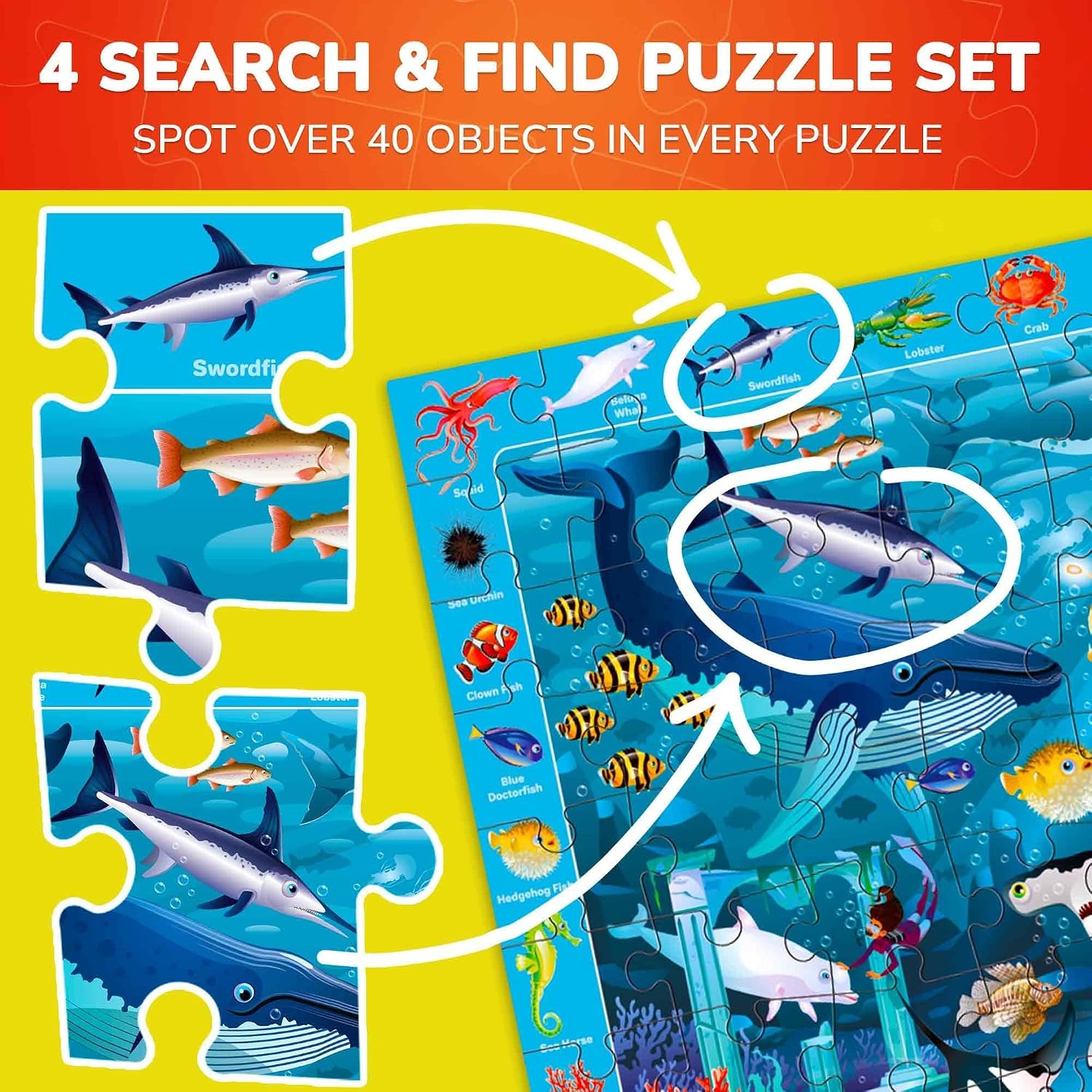
That design choice changes what happens when the puzzle is finished. With most children's jigsaws, completion is the end. You look at it, say well done, and sweep it into the box. Here the completed picture becomes a hunting ground. You ask your child to find the small green dinosaur in the corner, or count how many birds are in the scene, and suddenly there is another ten minutes of play from something that was already finished.
This is also where a lot of the quiet learning happens. Naming animals, spotting colour differences, holding a target in mind while scanning a busy image. The product lists animal recognition, colour recognition, concentration, memory and matching skill among its educational objectives, and the search-and-find artwork is doing most of that work.
Pieces that help rather than hinder
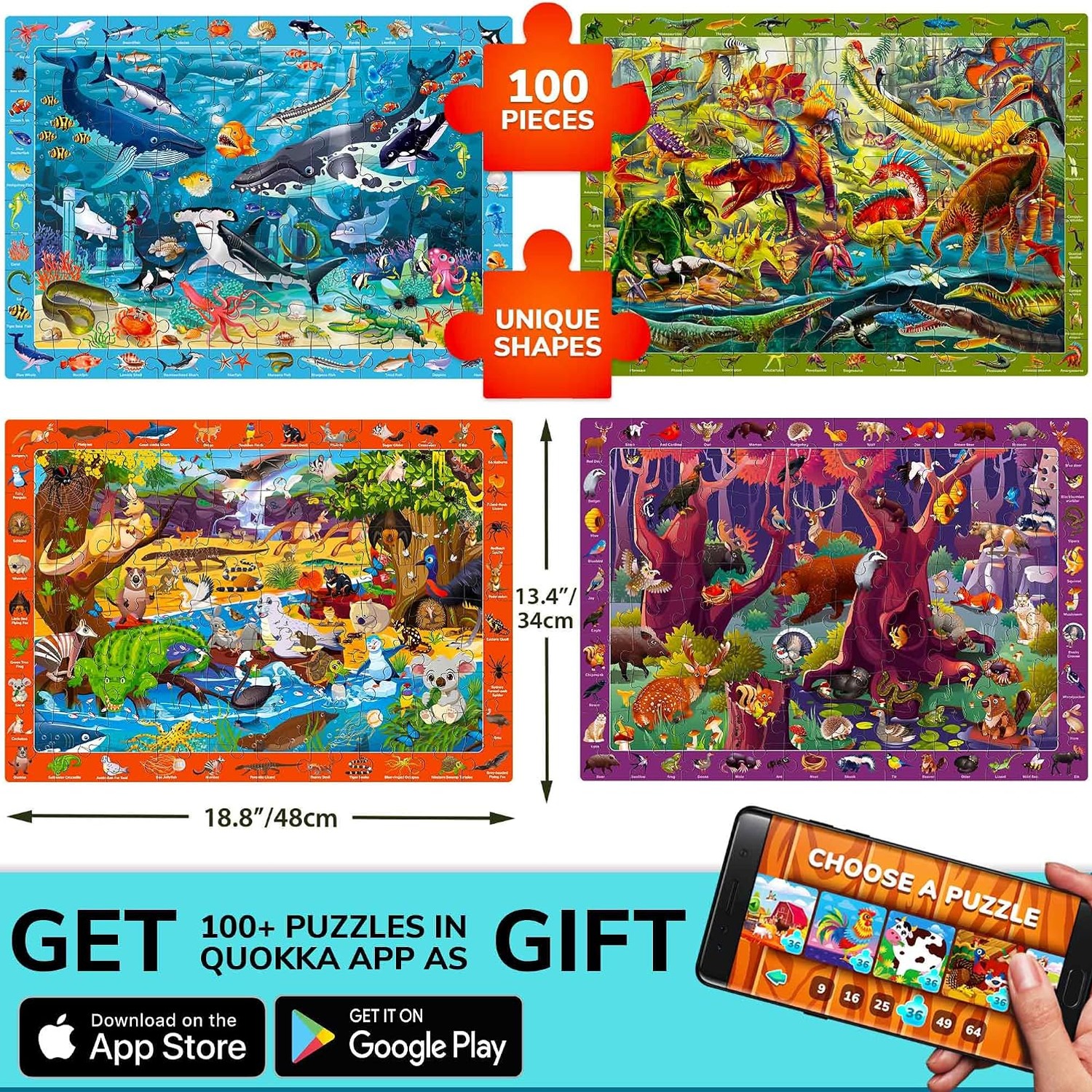
Every piece in these puzzles is cut to its own shape. That sounds like a small manufacturing detail, and it is the single thing that most affects whether a child enjoys the experience.
Cheap puzzles often use repeating cut patterns, which means several pieces will physically fit a gap even though only one is correct. A child pushes a piece in, it sits flush, and the picture is wrong. They either do not notice and build a mess, or they notice and lose confidence. With uniquely shaped pieces, a piece fits or it visibly does not. The puzzle corrects the child without anyone having to say anything.
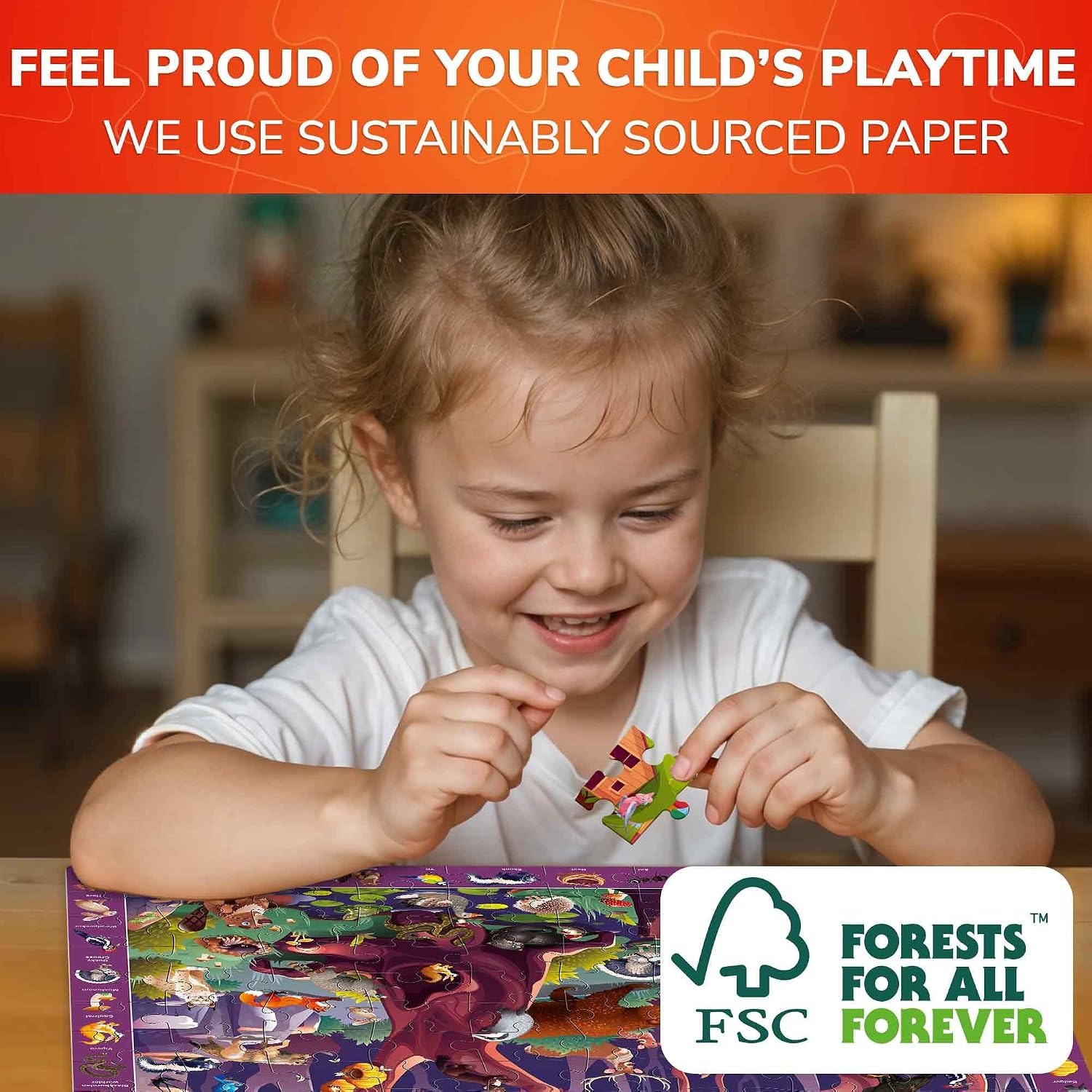
The cardboard is described as sustainable renewable stock, cut thick enough to be handled repeatedly. Exact thickness is not specified by the maker, but the pieces are intended to survive multiple builds rather than one.
Working out if the age fits
QUOKKA gives a recommended age range of 36 months to 10 years, with a beginner skill level. That is a wide window, and it helps to know where your own child sits in it.
If your child regularly finishes 48-piece puzzles without much help, they are ready. One hundred pieces will stretch them for a few builds, then become comfortable. If 48 pieces still takes concentration and a bit of adult input, these will work but plan to build the first one together. Sort the edges, get the frame down, then let them fill in from there. The frame is the part that feels like work and the middle is the part that feels like progress.
At the older end, an eight or nine year old will likely finish one in under half an hour. That is fine. At that age the value shifts from the challenge to the artwork and the search-and-find play. It also makes these useful as something an older child does alongside a younger sibling without being bored.
For children under three, the piece count is too high and cardboard pieces are a choking risk. The 36 month minimum is there for a reason.
Where to build and how much space you need
Each finished puzzle covers about 48 cm long by 34.2 cm wide. The play location is listed as tabletop and indoor, which is sensible, though plenty of families spread these on the floor.
Whatever surface you choose, allow more room than the finished size. You need space to spread pieces face up alongside the build, otherwise the child spends the whole session rummaging through a pile. A simple trick is a tray or a shallow baking sheet for unplaced pieces. It also means an unfinished puzzle can be moved off the table at dinner time without losing progress.
Avoid carpet with a deep pile. Pieces sink into it and the edges catch. A rug, a low table or a cleared dining table all work better.
Keeping four puzzles from becoming one mess
This is the thing that decides whether a four-pack lasts a month or three years. Each puzzle comes in its own box with the finished artwork printed on the front, and the discipline is simple. One puzzle out at a time, everything back in its own box when you are done.
If pieces do get mixed between boxes, it is recoverable. The four scenes have different colour palettes, so spreading everything out and grouping by dominant colour sorts most of it quickly. It is an annoying afternoon rather than a disaster.
Keep the boxes dry. Cardboard and moisture are a bad combination, and a damp garage or loft will warp pieces over a season. A cupboard shelf indoors, stored flat rather than with heavy things stacked on top, is all that is needed. Wipe hands before a session, because sticky fingers transfer onto the printed surface and never quite come off.
As a gift
A four-pack makes a better present than a single puzzle for an obvious reason. It survives the first day. A child who opens one puzzle on a birthday morning has finished it by lunch. A child who opens four has something left for the week.
The animal and dinosaur theme also lands fairly broadly, which matters when you are buying for someone else's child and do not know their current obsession. It is an easier choice than a licensed character set that might be last year's favourite.
Worth knowing before you buy as a gift: the manufacturer lists a 30 day warranty against manufacturer defects, the country of origin is China, and the manufacturer on record is Adducate Ukraine LLC. The maker does not state GTIN.
The short version
Four 100-piece jigsaw puzzles, each finishing at about 48 cm by 34.2 cm, with animal and dinosaur search-and-find artwork. Beginner skill level, recommended for 36 months to 10 years, made from sustainable renewable cardboard with uniquely shaped pieces that help children self-correct.
Buy it if your child has outgrown 48-piece boards and you want something that lasts past the first afternoon. Buy it if you have two children of slightly different ages and are tired of refereeing. Skip it if your child is already comfortable with 300 pieces, because these will be finished too fast to hold them.
Four boxes, 400 pieces, one quiet afternoon at a time.