

The complete guide
How to Choose a Toss and Catch Ball Set That Actually Gets Played
The problem with most garden games
Buy a bat and ball, hand it to a seven-year-old and a four-year-old, and watch what happens. The older one hits it too hard. The younger one swings and misses. Within ten minutes somebody is crying and the ball is in next door's garden.
That is not a child problem. It is an equipment problem. Traditional catching games demand a skill the players have not built yet, and they punish every mistake by making somebody run thirty metres to fetch the ball. The game design works against the people playing it.
A toss and catch ball set takes a different approach. Instead of asking a beginner to time a catch perfectly, the paddle face holds the ball as soon as it touches. The throw still has to be reasonably accurate. The catch still needs you to move your feet and get the paddle in the right place. But the final millisecond, the part that trips up most kids, is handled for you.
The result is a game where rallies actually happen. Kids count catches instead of counting drops. The ball stays in play. And because the ball is not bouncing off into the distance every thirty seconds, the group keeps its momentum.
How the sticking works
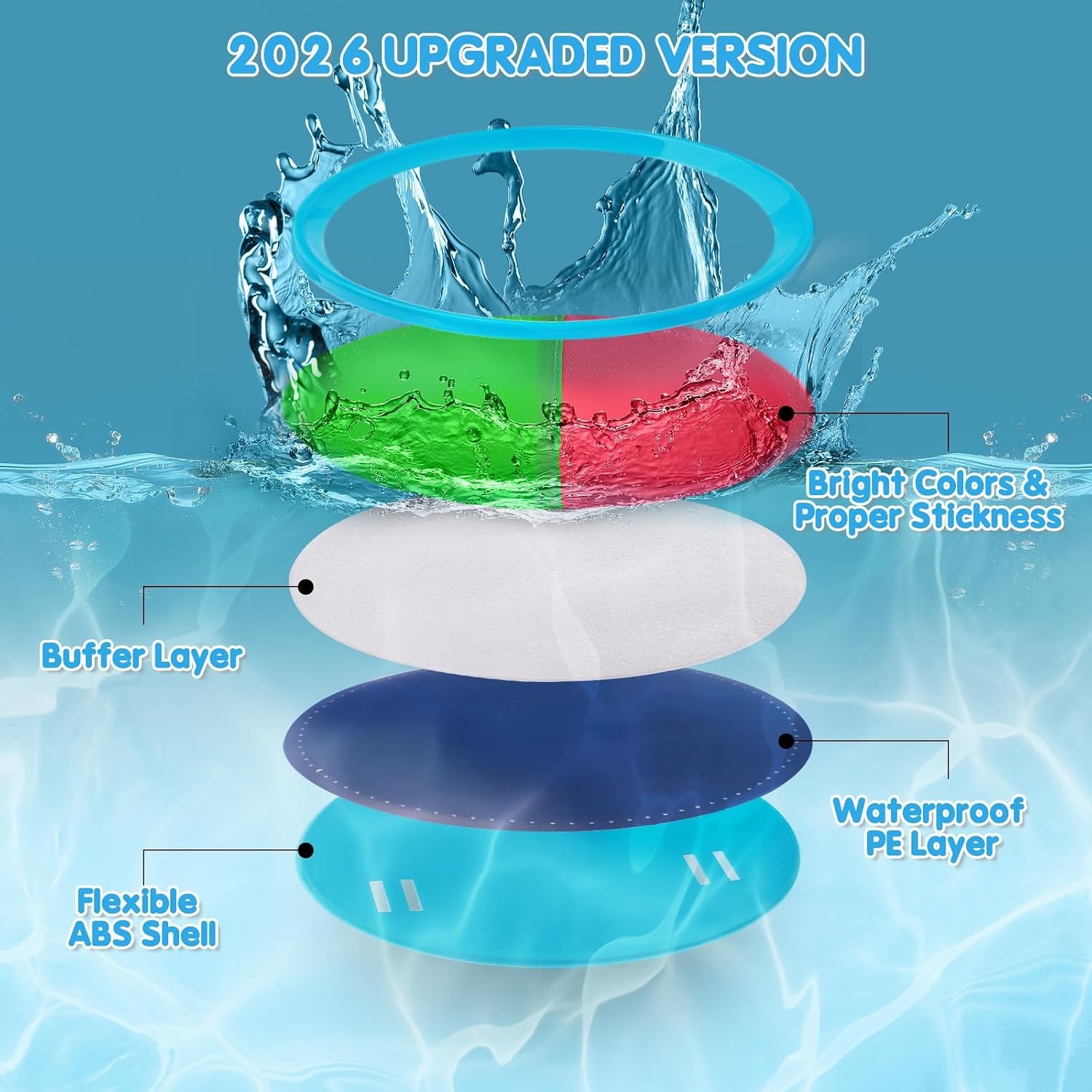
The paddle surface and the ball are designed to grab each other. When the ball lands on the face of the paddle, it holds rather than rebounding. To throw it again, you peel it off and flick it back.
There is nothing clever or fragile about this. There are no moving parts, no batteries, no electronics. The listed operation mode is manual, which is a formal way of saying it is powered entirely by arms.
The only thing that affects performance over time is debris. Grass seeds, pet hair, sand and clothing fibres work their way into the gripping surface and gradually reduce how well it holds. The fix is simple. Pick the surface clean with your fingers now and then, and store the set in its bag instead of leaving it loose in a toy box or the boot of the car.
Why four paddles matters
Plenty of catch sets come with two paddles. That is fine if you only ever have two players, but it is a frustration in most households. One child plays, the other waits. A parent joins in and now there are three people and two paddles.
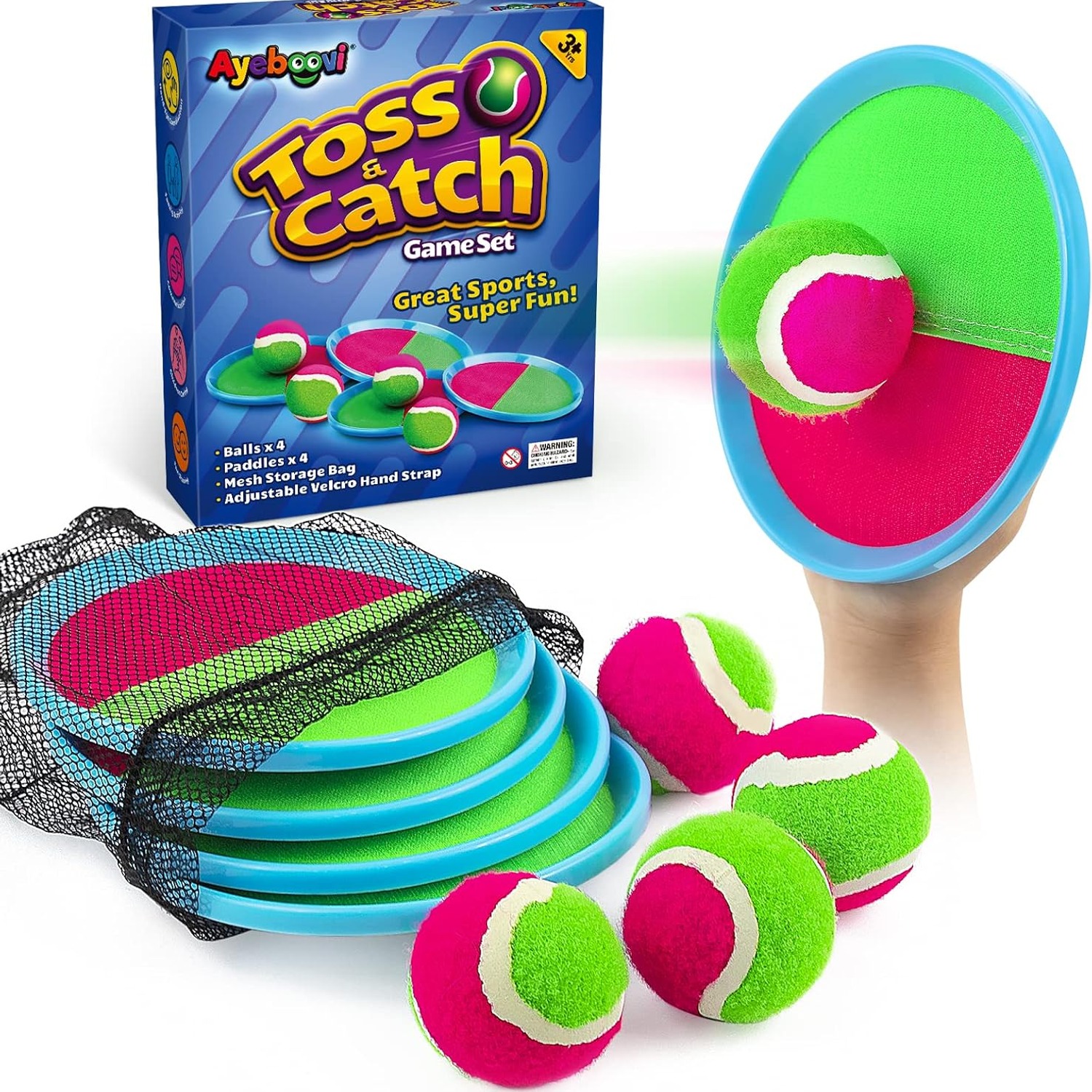
This is the Family Edition, listed as a 4 count set with four paddles and four balls. That changes the social shape of the game completely. Two pairs can play at once in opposite corners of the lawn. Four players can stand in a square and throw across the diagonals, which is harder and much funnier. Someone can drop out for a drink without ending the game.
It also means a spare. Paddles get left at the park. Balls roll under hedges. Having four of each buys you a lot of forgiveness.
With four players the recommended number is right there in the specification, listed as 4 players. That is not a hard limit, though. Larger groups just take turns, which works well at a party or in a PE lesson.
Who it suits
The manufacturer recommends it from 3 years and up, with a listed range running from 36 months to 80 years. In practice the sweet spot is wide.
Very young children play it close in, almost handing the ball across, and still get something out of it. Primary-age kids are the core audience, and this is where you see the biggest jump in ability over a summer. Teenagers and adults make it competitive by backing up and throwing low and fast.
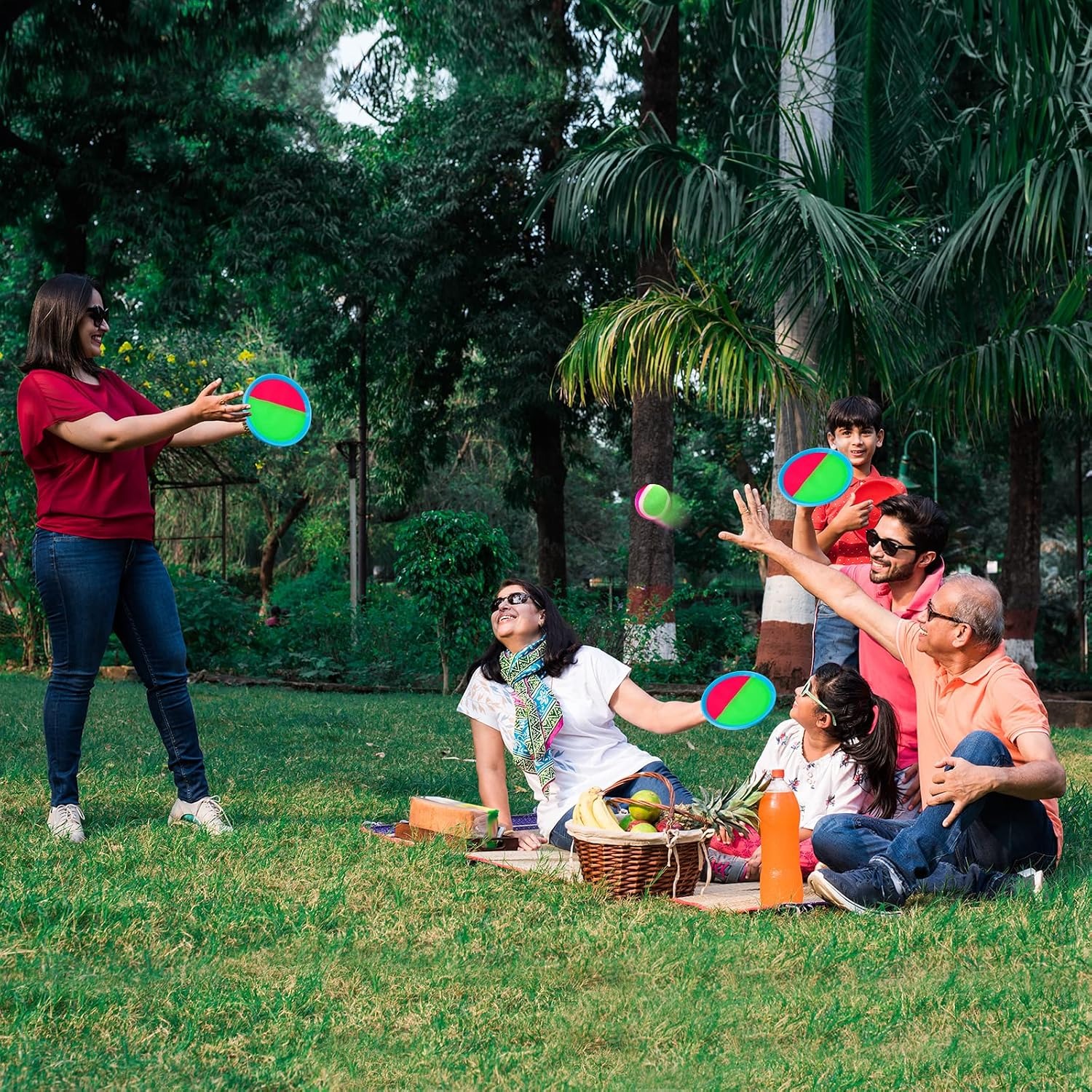
It also suits groups where abilities are mixed. A grandparent can stand still and throw gently while a grandchild runs around. Nobody has to be good at it for the game to work, which is rare in ball sports.
For anyone searching for the best outdoor game for kids who are not naturally sporty, this is worth a look. The low failure rate is the whole appeal.
Where you can play it
Grass is the obvious answer, but the set handles a lot more than that.
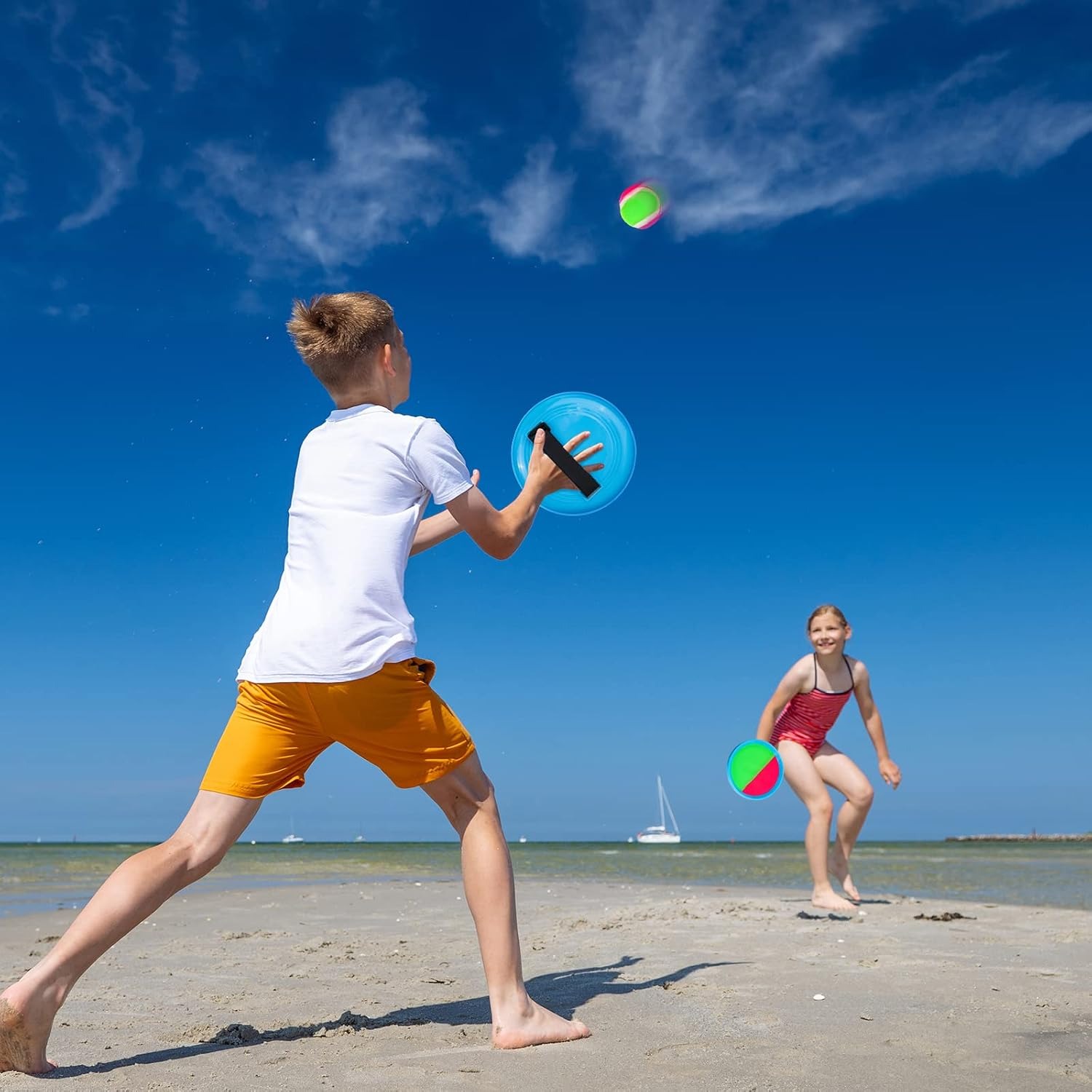
Sand works, which is unusual. A tennis ball or a bouncy ball dies instantly on soft sand, but a sticking ball does not care about bounce at all. That is why it travels so well to the coast.
Hard surfaces are fine too. A driveway, a playground, a campsite pitch or a car park all work because the ball is not relying on a surface rebound. You just need a bit of space around the players.
Indoors is possible in a hall, a gym or a big open space with a high ceiling. A normal living room is usually too tight, and you will knock something over eventually.
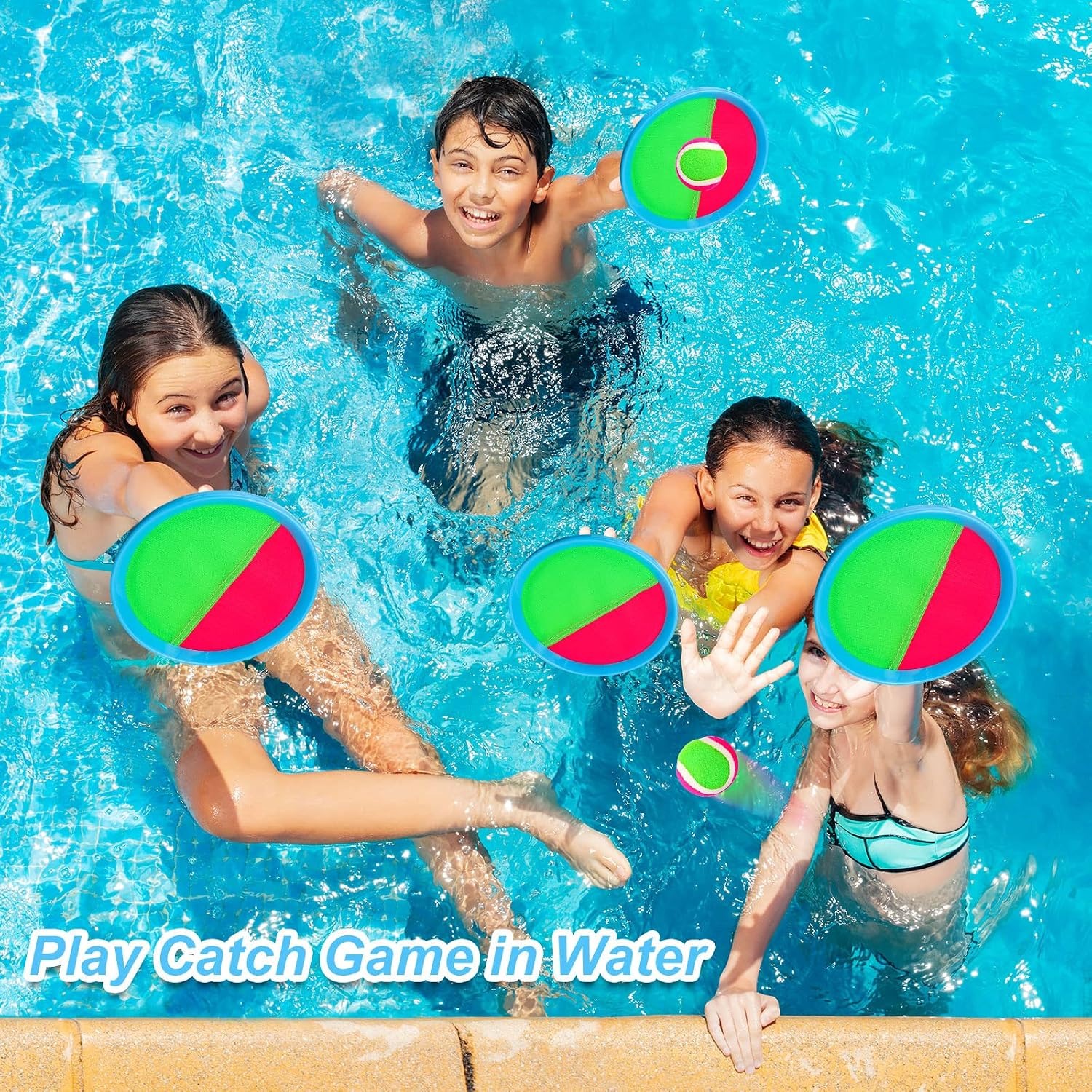
Poolside is a popular one. The set is not intended as a water toy, so let it dry out properly rather than leaving it floating or soaking, but a few splashes are nothing to worry about.
What to look at before you buy
A few things separate a set that gets played all summer from one that ends up in the shed.
Start with the number of paddles. Two is limiting. Four gives you real flexibility and a spare.
Look at the weight and packed size if you plan to travel with it. This set is listed at 608 g total with item dimensions of 25.15 x 23.37 x 7.11 cm, which is genuinely packable. A heavy set stays at home.
Check whether a bag is included. It sounds minor, but a loose set of paddles rolling around a trunk picks up grit on the gripping faces and loses performance much faster.
Think about the age of the players. Something listed from 3 years and up suits a family with a wide age spread better than a set designed for older children only.
Finally, consider how many hands will be on it. A set bought for one child gets used a handful of times. A set that four people can share gets dragged out every weekend.
Looking after it
None of this is complicated, but a few minutes of care makes a real difference.
After a beach or garden session, shake the paddles out and brush the gripping face. Grass seeds are the worst offender because they bury themselves in the surface and are fiddly to remove later. Doing it straight away takes seconds.
Wipe the paddles and balls with a damp cloth when they get properly dirty, then let them air dry completely before packing them. Trapping moisture in a closed bag is how things start to smell.
Keep the set out of long periods of direct sun. Plastic left baking on a patio all summer does not last as well as plastic stored in the shade.
Do not machine wash or tumble dry any part of it. The gripping surface is the one thing you really do not want to damage, and a washing machine will fill it with fibres.
Getting more out of the game
Once the basic throw-and-catch gets easy, change the rules. Count consecutive catches as a team and try to beat the record. Take one step back after every success until somebody drops it. Play elimination where a drop puts you out. Throw with your weaker hand. Make players catch one-handed behind their back.
For a group, a square formation with four players and two balls in play at once is chaotic and brilliant. For a single child practising alone, throwing against a wall and catching the rebound builds accuracy fast.
Teachers and camp leaders often use this kind of game as a five-minute warm-up because it needs no explanation and no setup. Hand out paddles, point at a space, done.
The short version
If you want a garden or beach game that mixed-age groups can play together without anyone getting frustrated, a paddle set with a gripping face is a smart buy. This one comes with four paddles and four balls, is listed from 3 years and up, weighs 608 g in total, and needs no batteries or assembly.
It will not teach anyone to play tennis. What it will do is get a group of people outside, moving, and laughing at each other's throws for an hour at a time. For most families that is the only test that matters.