
The complete guide
How To Choose A Wooden Puzzle Set For A Child Aged 3 To 8
The problem with most puzzles bought for small children
A puzzle gets bought, opened on a birthday, finished once with help, and then lives in a cupboard with three pieces missing. That pattern is so common that plenty of parents stop buying puzzles altogether, which is a shame, because a good one does something that very few quiet activities manage. It holds a child's attention without a screen, and it does it for free, every time, with no batteries.
Two things usually cause the cupboard problem. The first is difficulty. A puzzle that is too easy gets solved and abandoned, and one that is too hard produces a meltdown and never comes out again. The second is build quality. Thin card pieces curl at the corners within weeks, and once a few pieces are bent the picture will not sit flat, which makes the whole thing feel broken even when every piece is still there.
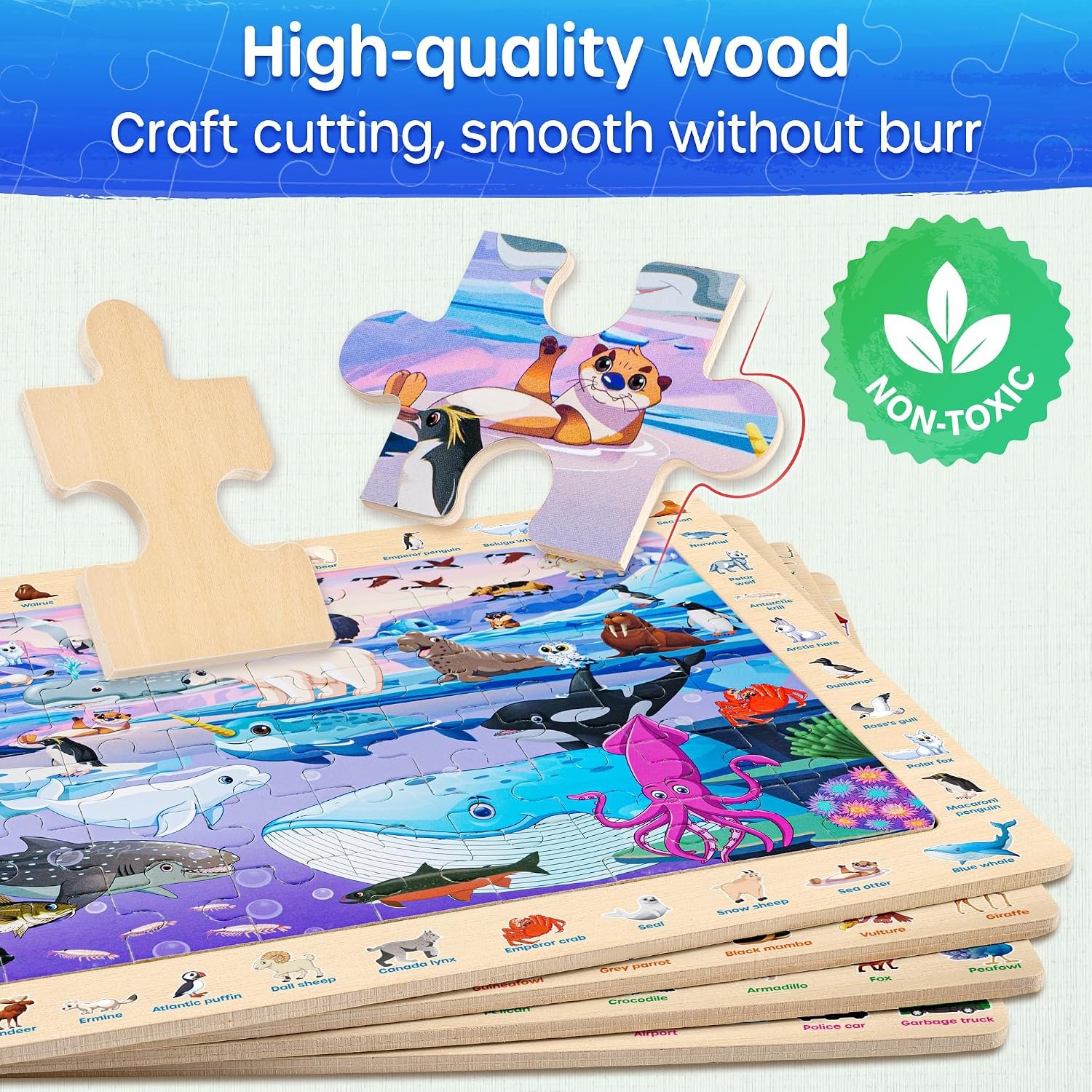
A wooden four pack like this one is built around both problems. Four different scenes means the novelty does not run out after one sitting. Wooden pieces mean the set still works a year later. That is the basic case for it.
What you are actually getting
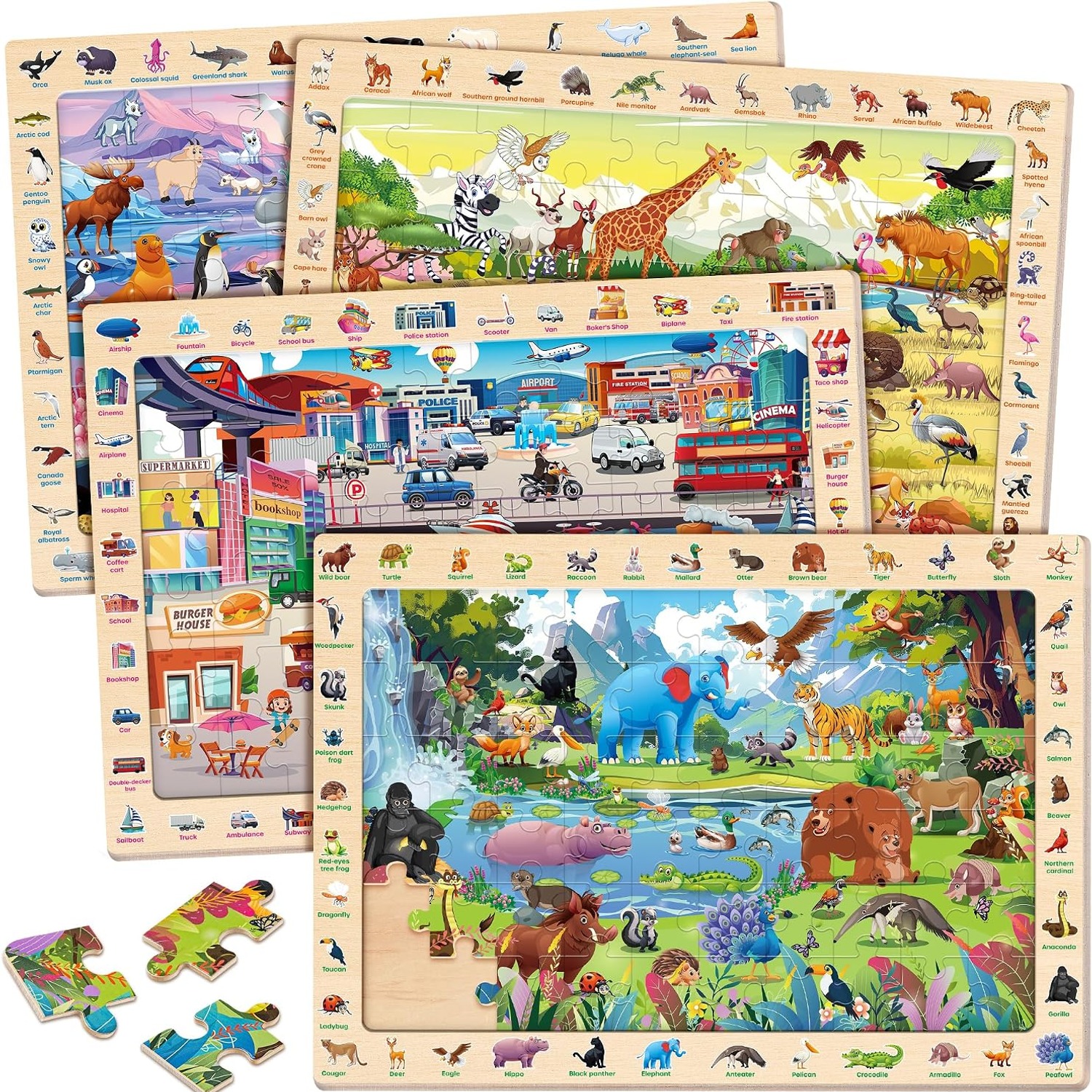
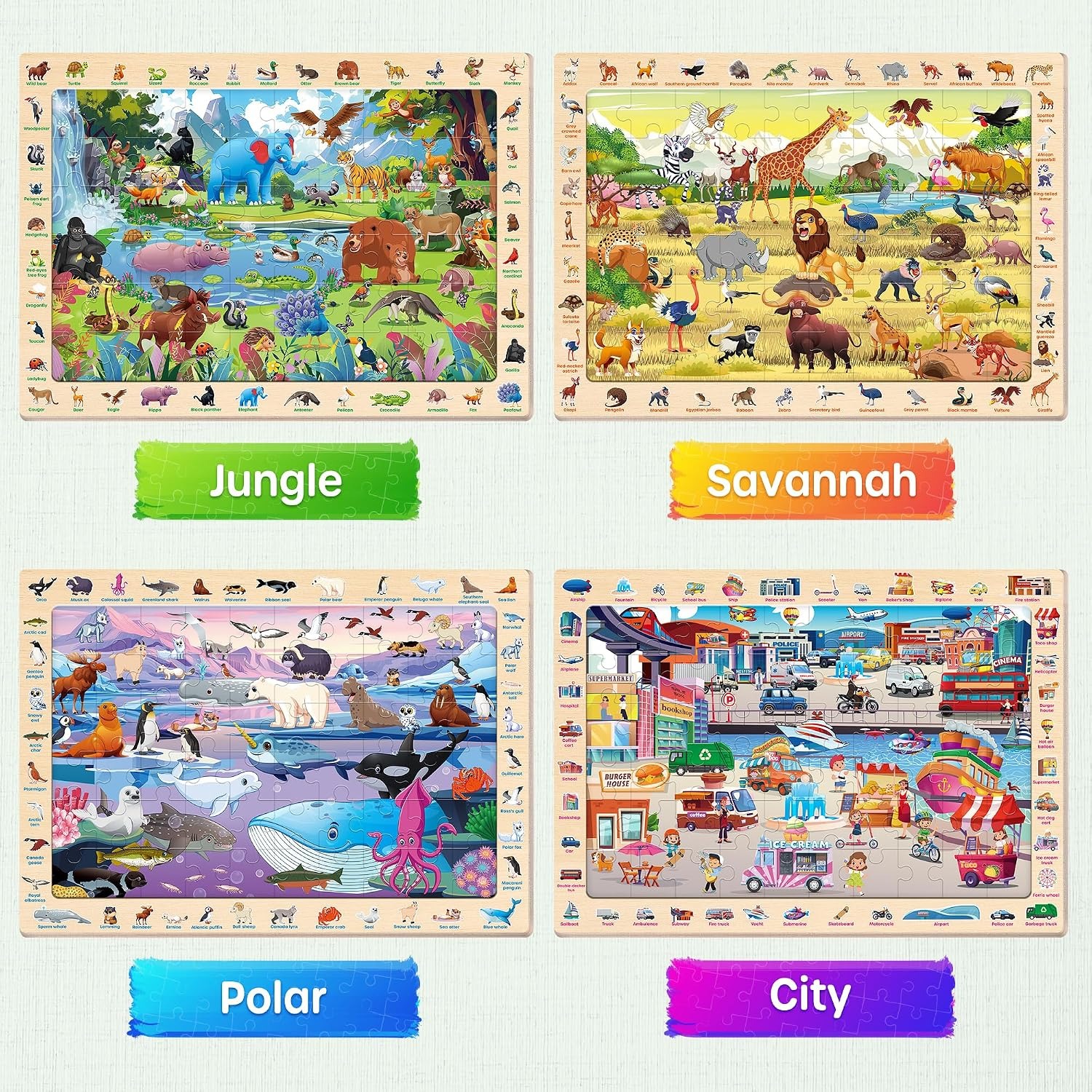
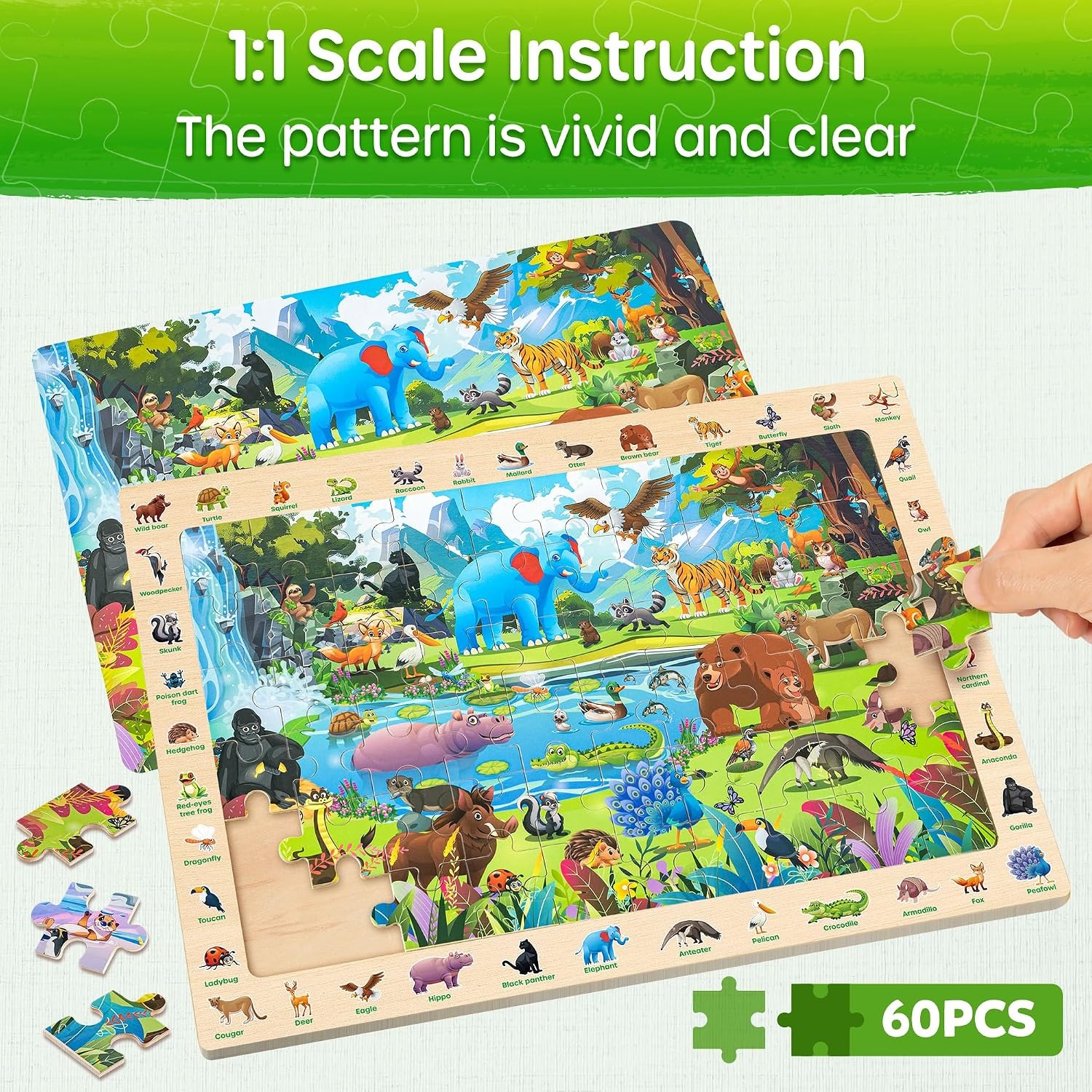
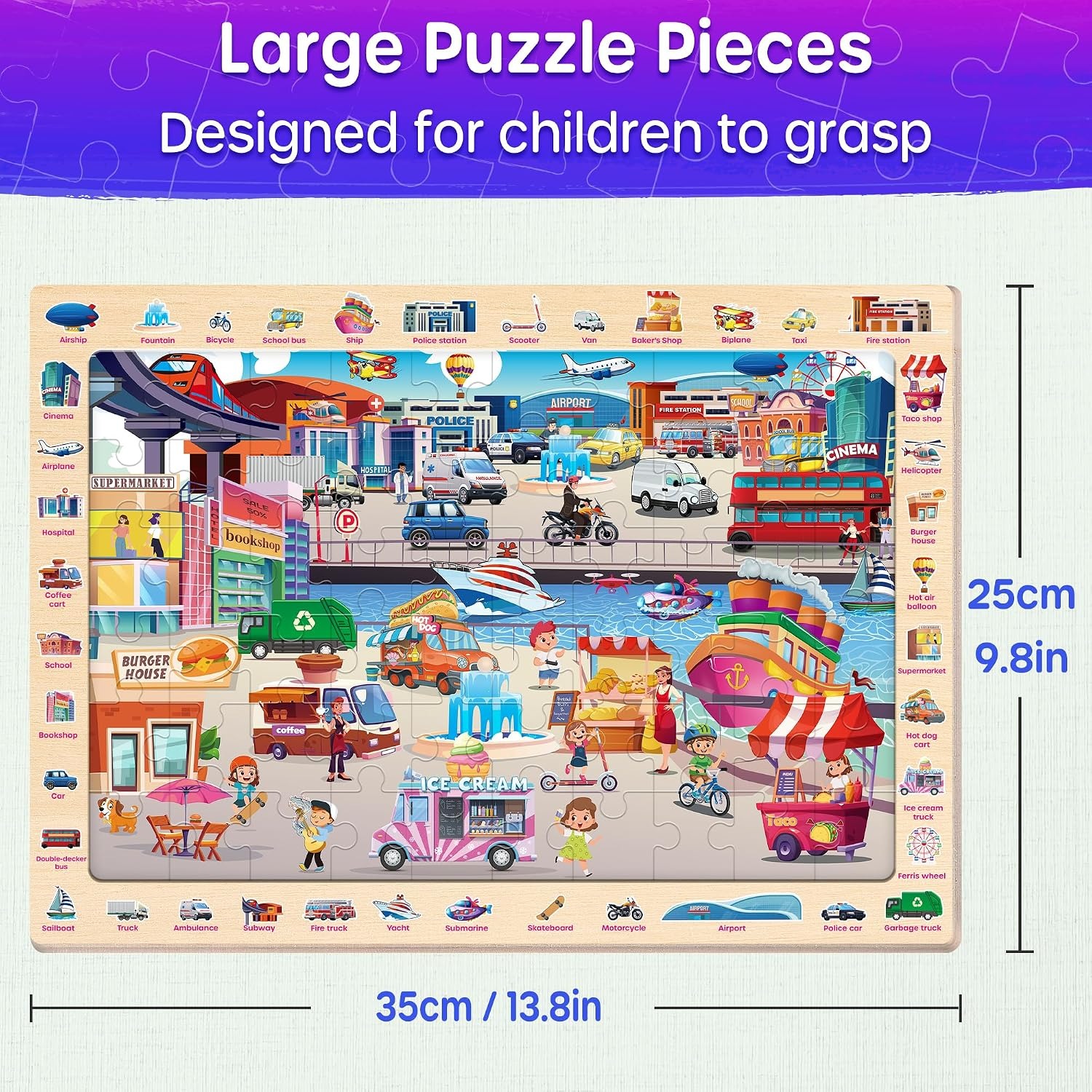
The box holds four separate wooden jigsaw puzzles. Each has 60 pieces, and each has its own scene: jungle animals, polar animals, African savanna animals, and city life. Finished, each puzzle measures 35.5 by 26 centimetres, which fills a decent patch of a kitchen table and is easy to see from a standing adult's eye level.
Each puzzle sits in a frame. People underestimate how much this matters for beginners. A frame gives a child a fixed boundary, so the question stops being "where does this go in infinite space" and becomes "where does this go inside this rectangle". It also means a half-finished puzzle can be carried to a shelf without becoming a pile on the floor, which is often the difference between a puzzle that gets finished over two days and a puzzle that gets abandoned.
The manufacturer lists the skill level as beginner and the age range as 36 months to 8 years. One to four players, tabletop, manual operation. That last detail is the plainest possible way of saying there is nothing to charge.
How a 60 piece puzzle actually works for this age group
Sixty pieces sounds like a lot if you are picturing a three year old. In practice, 60 is a well-chosen number for the four to six band. It is enough that a child has to use a strategy rather than brute force, but not so many that the sorting stage becomes miserable.
The strategy part is where the learning sits. Most children work out the same sequence that adults use, given a few tries: find the straight edges, build the frame, then group pieces by colour and work inward. Nobody has to teach this. It emerges from doing it, and once it emerges a child can apply it to any puzzle they meet later. That is the real value of a beginner jigsaw puzzle, more than the picture on the front.
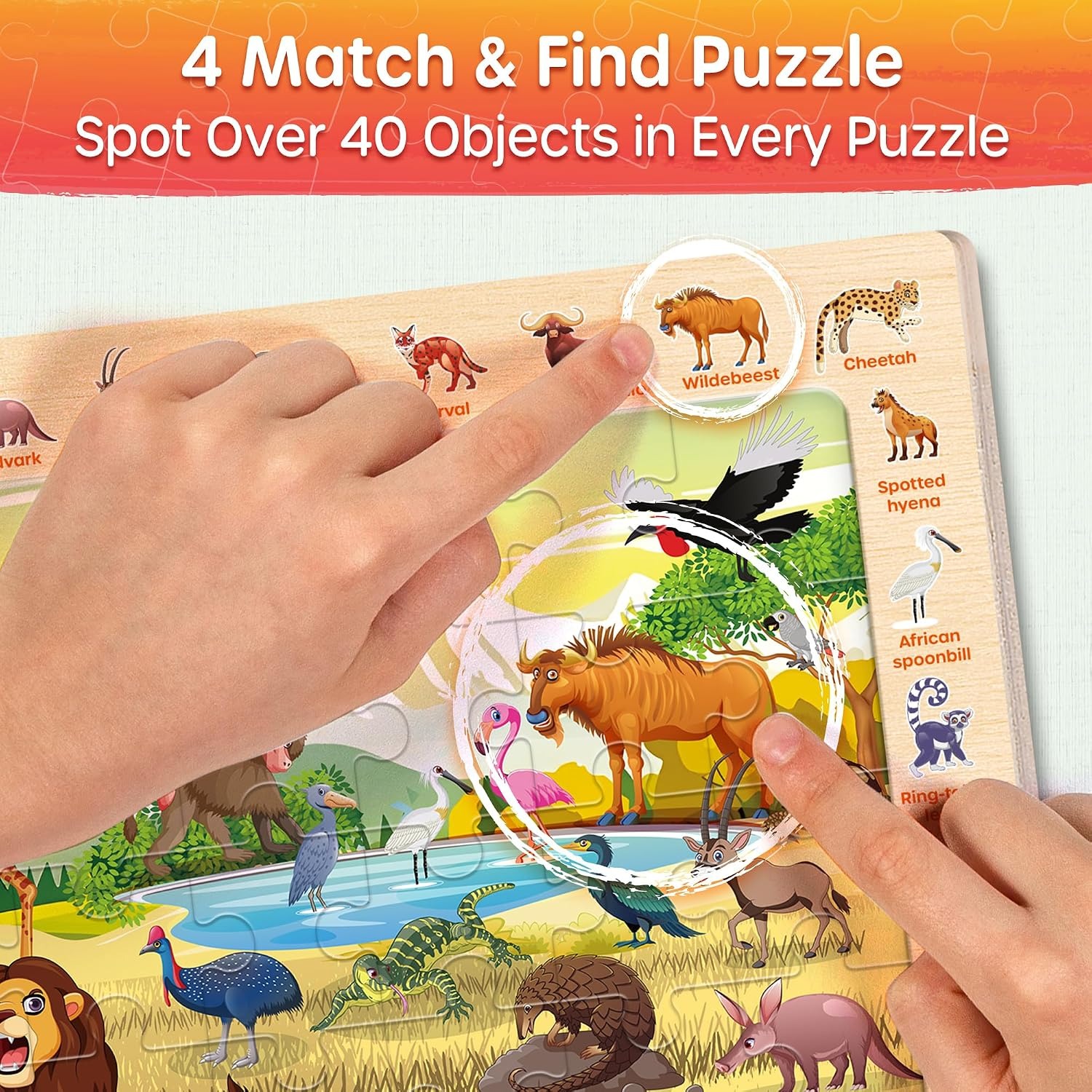
The match and find layer gives the set a second life after the building is done. The scenes are busy, with creatures tucked into the background, so "find the one with the stripes" turns a finished puzzle into a looking game. This is where the observation and concentration objectives in the product details actually land.
Who this suits and who it does not
A four to six year old is the sweet spot. At that age, 60 pieces is a genuine challenge that can be met in one or two sittings, and the animal themes are still exciting rather than babyish.
A three year old can use the set, but expect it to be a shared activity. Most will sort by colour, match a few pieces, and lose interest before completion. That is fine and still useful, but do not buy it expecting independent play at that age.
A seven or eight year old sits at the top of the range. They will finish a puzzle quickly, so the appeal shifts to speed, to doing all four, or to the hidden-animal hunt. If the child in question already builds 200 piece puzzles without help, this set will feel light, and you would be better off with something larger.
It also suits households with more than one child, because four framed puzzles means four people can work at the same table without fighting over the same picture.
How to choose between puzzle sets
A few things are worth checking whenever you compare wooden puzzles for kids.
Piece count against age is the first filter. Below four years, 20 to 40 pieces is more realistic. Four to six years, 48 to 72 pieces is the usual band, which is where this set sits. Above seven, most children can handle 100 plus.
Material is the second. Wood versus card is not snobbery, it is about how many times the puzzle can be built. Wood survives being dropped, stepped on and stacked. Card does not.
Then look at whether there is a frame or tray, because it changes how usable a puzzle is day to day. Check for a reference picture too. Children need something to look at while they build, and a set that only prints the image on the outer box is less helpful than one that includes a separate picture.
Finally, count the scenes. One picture is one activity. Four pictures in a puzzle gift set for kids gives you repeat value for not much more money, and it spreads the appeal across a wider age gap if you have more than one child.
Looking after wooden puzzles
Wood is forgiving but not indestructible, and the enemy is moisture. Wipe pieces with a dry cloth or one that is barely damp, then dry them immediately. Never soak them, run them under a tap, or let them sit in a puddle of spilled juice, because water swells wood fibres and a swollen piece will not sit flush again.
Store each puzzle flat in its frame if you have the shelf space. If you need to break them down, bag each scene separately. Mixing 240 pieces into one tub is how puzzles get retired early.
Keep the set out of direct sunlight and away from radiators. Sun fades printed colour over time, and dry heat is not kind to wood.
If a piece does go astray, check under the sofa before you panic. Wooden pieces are heavy enough that they tend to stay where they fell rather than blowing around the house.
The short version
This is four framed wooden jigsaw puzzles in one box, 60 pieces each, covering jungle, polar, savanna and city scenes. Finished size is 35.5 by 26 centimetres per puzzle. The maker lists it for ages 36 months to 8 years at beginner level, for one to four players at a table.
It is a good fit if you want a screen-free activity for a four to six year old, if you have more than one child who needs their own puzzle, or if you want a gift that does not need unwrapping into a dozen small parts. It is less of a fit for a confident older child who has already moved past 100 pieces.
Wood instead of card is the part that decides whether a puzzle lasts a season or several years. That, plus four pictures rather than one, is the whole argument for this set.