

The complete guide
How to Choose a Wooden Farm Train Set That Actually Gets Played With
The toy that gets played with twice
Most families have one. A train set, bought with good intentions, that came out on Christmas morning and went back in the cupboard by New Year. It is rarely the child's fault. It is usually because the set was a loop of track and two carriages, and a loop of track is a shape, not a game.
A child pushes the train around. Then they push it around again. Then they want to know what happens next, and nothing does, because there is nowhere to go and nothing to carry.
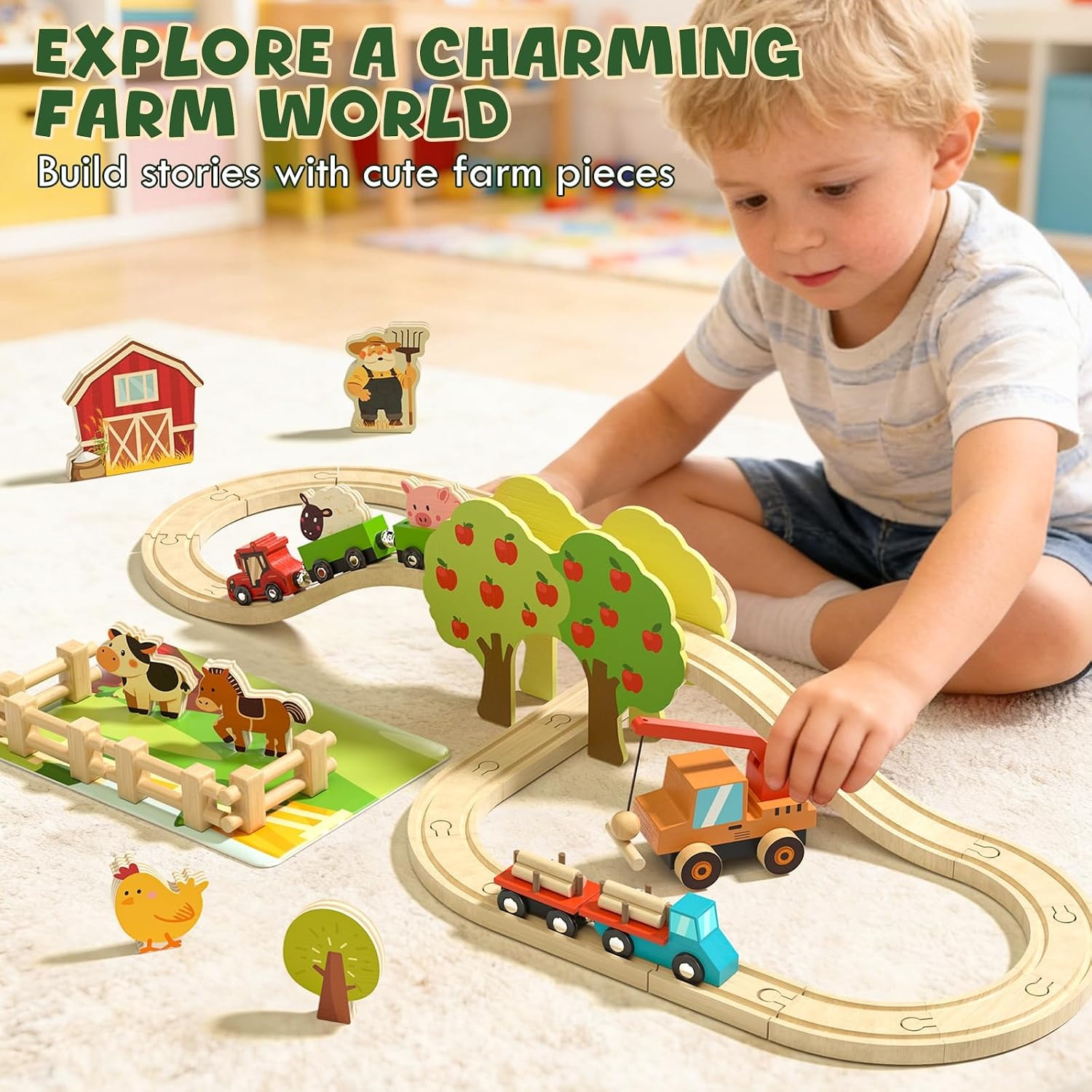
That is the gap a farm-themed set fills. When the track runs past a barn with animals in it, under an apple tree tunnel, and up to a crane that can load cargo onto a truck, the train suddenly has a job. The child is no longer watching a circle. They are running a delivery business, deciding that the sheep have to be moved before the hay arrives, and inventing rules about which trailer goes where.
How a wooden railway actually works
The mechanics are deliberately simple. Each track piece has a peg on one end and a groove on the other, so they slot together without tools or glue. Curves and straights combine into loops, figure-eights or sprawling lines, depending on how much track you have and how much floor you are willing to surrender.
There is no motor. The trains are pushed along by hand, which sounds like a limitation and is actually the point. A motorized train runs on its own schedule. A push-along train stops when the child wants it to stop, reverses when the story needs it to reverse, and gets picked up and carried across the room when a bridge is missing. Play stays in the child's control.
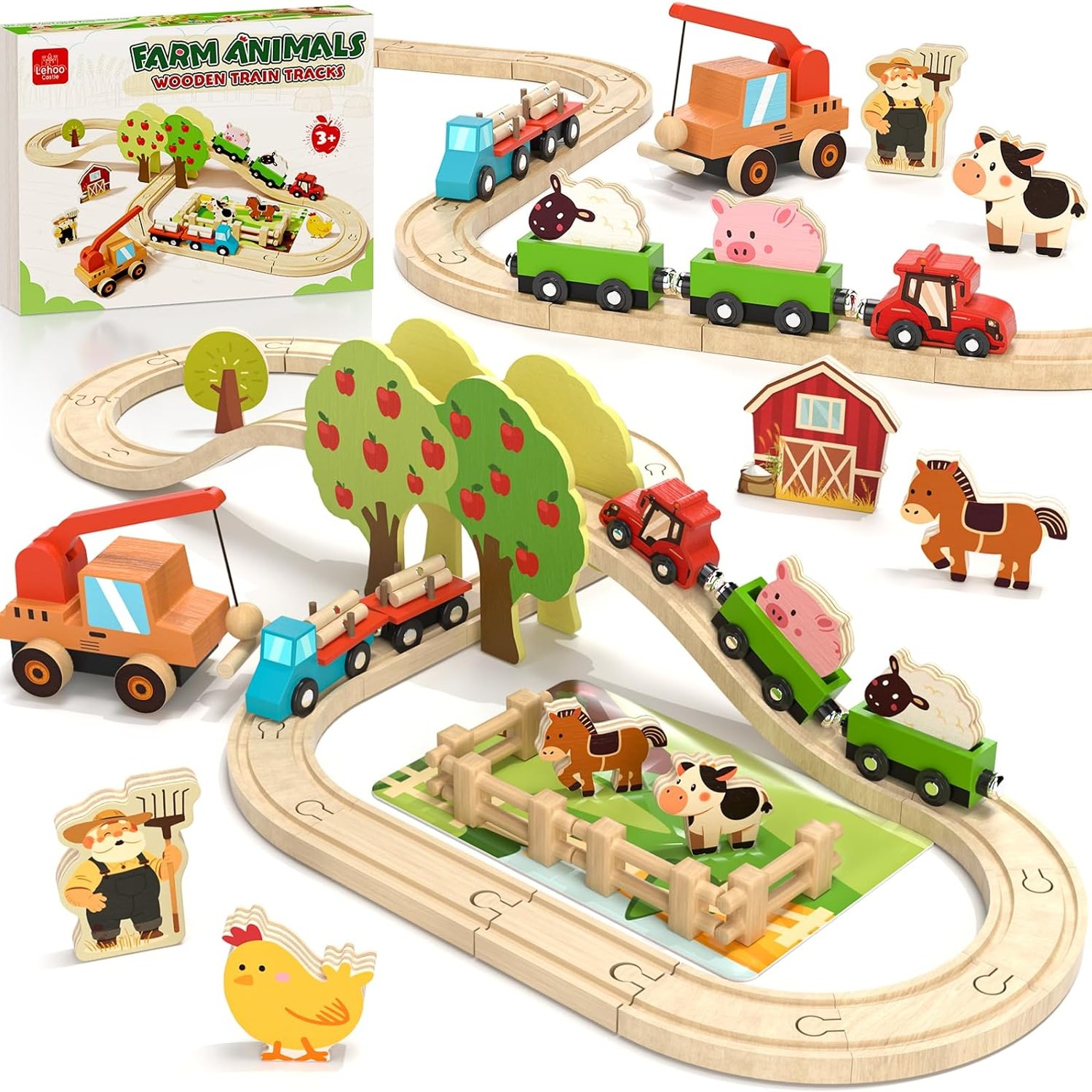
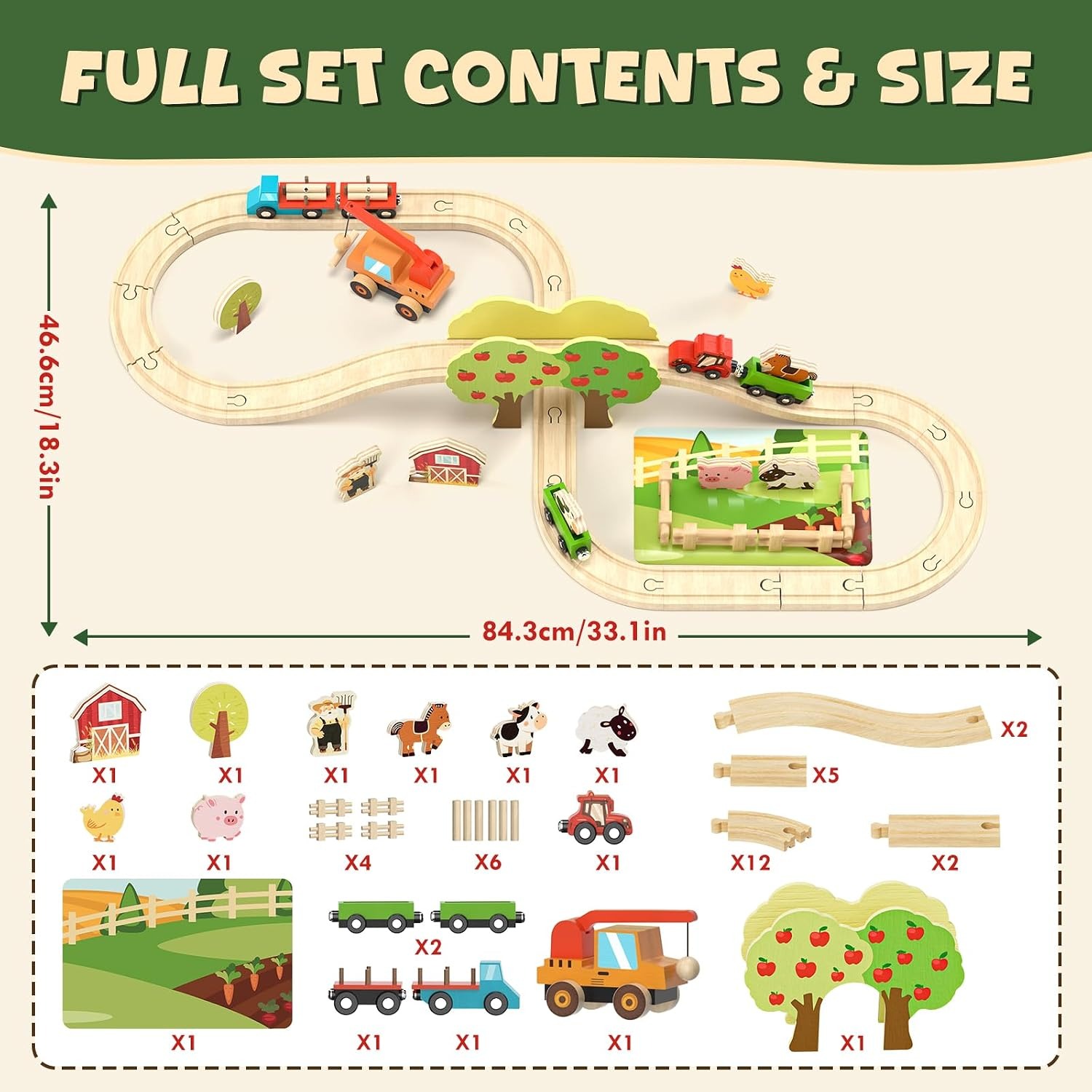
This set adds a second layer on top of the railway. The crane and cargo truck give a loading point. The tractor and its two trailers give a vehicle that leaves the track entirely and works across the playmat. The farmer figure, the five animals, the barn, the tree and the fences fill the middle of the layout with places and characters. That combination is what separates a five-minute toy from a ninety-minute one.
Assembly takes around five minutes. In practice that means tipping the box onto a rug and clicking the track together while the child is already lining up the animals.
Who it suits
The recommended range is 36 months to 12 years, which is wide, and it is worth understanding why.
At three, children mostly push and carry. They will roll the train, walk the cow over to the barn, and narrate loosely. The track might not form a closed loop and that is fine. Their interest is in the objects themselves.
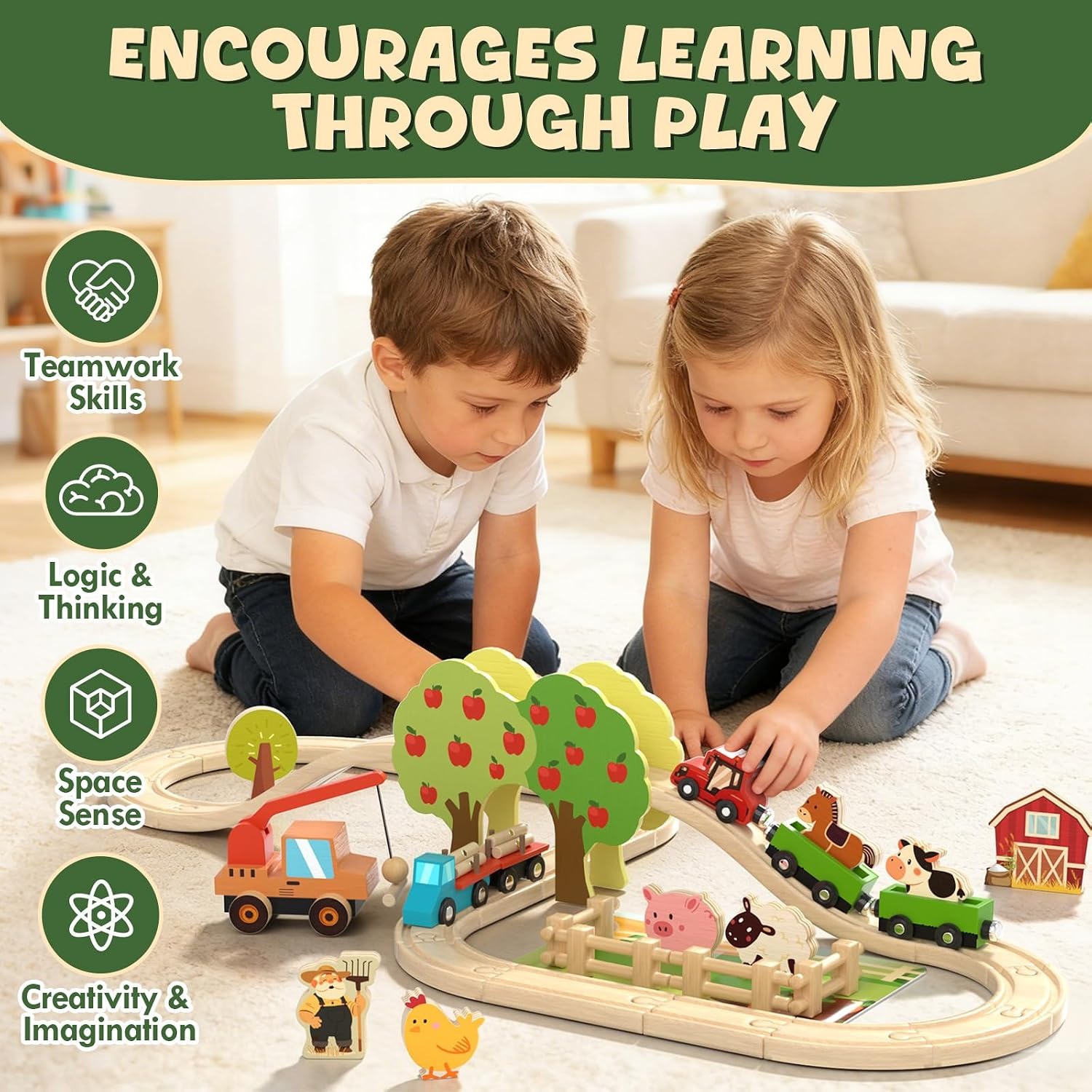
At four and five, something shifts. They start wanting the loop to close, which means working out that two curves facing the same way go in a circle and two facing opposite ways make an S. That is proper spatial reasoning, worked out by hand. They also start giving the animals names and histories.
By six and up, children build layouts with intent. They combine this set with any other track they own, plan routes, and set up scenarios that last across several days if you let them leave it out. Older siblings often take over the construction side while younger ones handle the animals, which is a surprisingly peaceful arrangement.
Because the piece count is 47 with multiple vehicles, two children can genuinely play at the same time. One takes the train, one takes the tractor, and nobody is standing around waiting.
What to look for when you compare sets
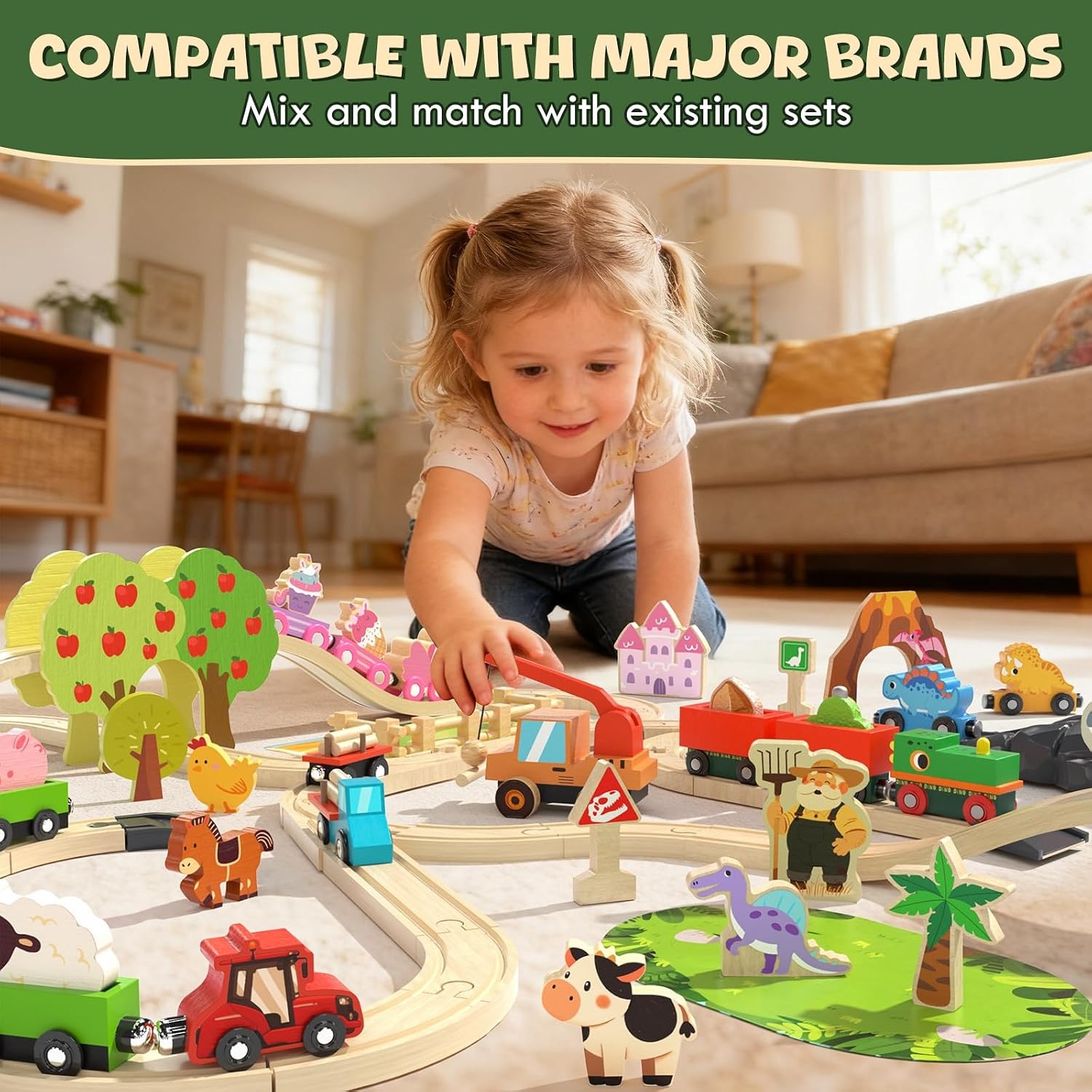
Compatibility first. This is the single biggest factor in whether a wooden railway stays in use. A set that only works with its own brand becomes a dead end. This one is built to fit most major wooden track systems, Brio included, so it either extends a collection you already have or becomes the base for one you build over time. If you are after the best wooden railway starter set, compatibility matters more than piece count.
Check what is not track. Piece counts can be misleading. Forty pieces of plain straight track is a worse toy than twenty-five pieces that include a barn, animals, a crane and a tunnel. Look at the breakdown. Here the accessory list does a lot of the work: barn, tree, playmat, four fences, six fence connectors, farmer, five animals, crane truck, tractor, two trailers, two train cars and the apple tree bridge tunnel.
Power or no power. Battery trains have appeal for about a week, then they need batteries, then they get left on and flatten, then they sit in a drawer. Non-powered sets keep working forever. If you want the best screen-free gift for kids, something with no electronics at all is a reasonable place to start.
Material and finish. Wood holds up better than thin plastic under real use. It does not crack along moulding lines, and when it does get marked, the marks look like character rather than damage. This set lists wood as its base, frame and overall material.
Storage. A set you cannot tidy away in two minutes becomes a source of friction. A contained set with a playmat, where everything fits back into one box, is far more likely to come out regularly.
Living with it day to day
Pick a spot. Hard floor is better than deep carpet, because track sits flat and trains roll properly. The playmat helps enormously here, both as a surface and as a visual boundary that signals where the farm ends.
Keep the animals and the small fence connectors in a separate pouch inside the box. Those are the pieces that disappear under the sofa, and a set missing its pig is noticeably less fun. Doing a quick headcount at pack-up time takes thirty seconds and saves a lot of searching later.
For cleaning, a damp cloth and a quick dry is all it needs. Avoid soaking, dishwashers and spray cleaners, all of which will raise the grain and dull the finish. Keep the box somewhere that is not next to a radiator or in a sunny window, because dry heat over months can make wood shrink and loosen joints.
If a train gets sticky, check the axles for carpet fluff. That is almost always the problem, and a fingernail or a pair of tweezers fixes it.
Growing the set later
One of the quieter advantages of a compatible wooden railway is that it gives you an easy answer to future birthdays. A pack of extra curves, a second bridge, a level crossing or a roundhouse all slot straight in. The farm becomes one district of something larger, and the child who built it feels ownership over the whole thing.
This also means you are not committing to one manufacturer's price list. Mix brands freely as long as the connectors match, and buy whatever represents good value at the time.
The short version
A wooden farm train set earns its place by giving children somewhere for the train to go. This one packs 47 pieces into a slim box, including a crane and cargo truck, a tractor with two trailers, a farmer, five animals, a barn, fences, an apple tree tunnel and a playmat, alongside the track itself. It needs no batteries, takes about five minutes to set up, and connects with most major wooden railway systems, so it can grow rather than get replaced.
Suitable from three years up, quiet, screen-free and easy to tidy, it is the kind of toy that tends to stay in the cupboard rotation for years rather than a single season.