Toy Warehouse
Company
Shop By Category
T&Cs
Shop Online
  • Box contents listed
  • Free tracked Canada-wide delivery over $125
  • 14-day returns

Kids Microscope and Telescope | Handheld digital microscope | Kids science kit

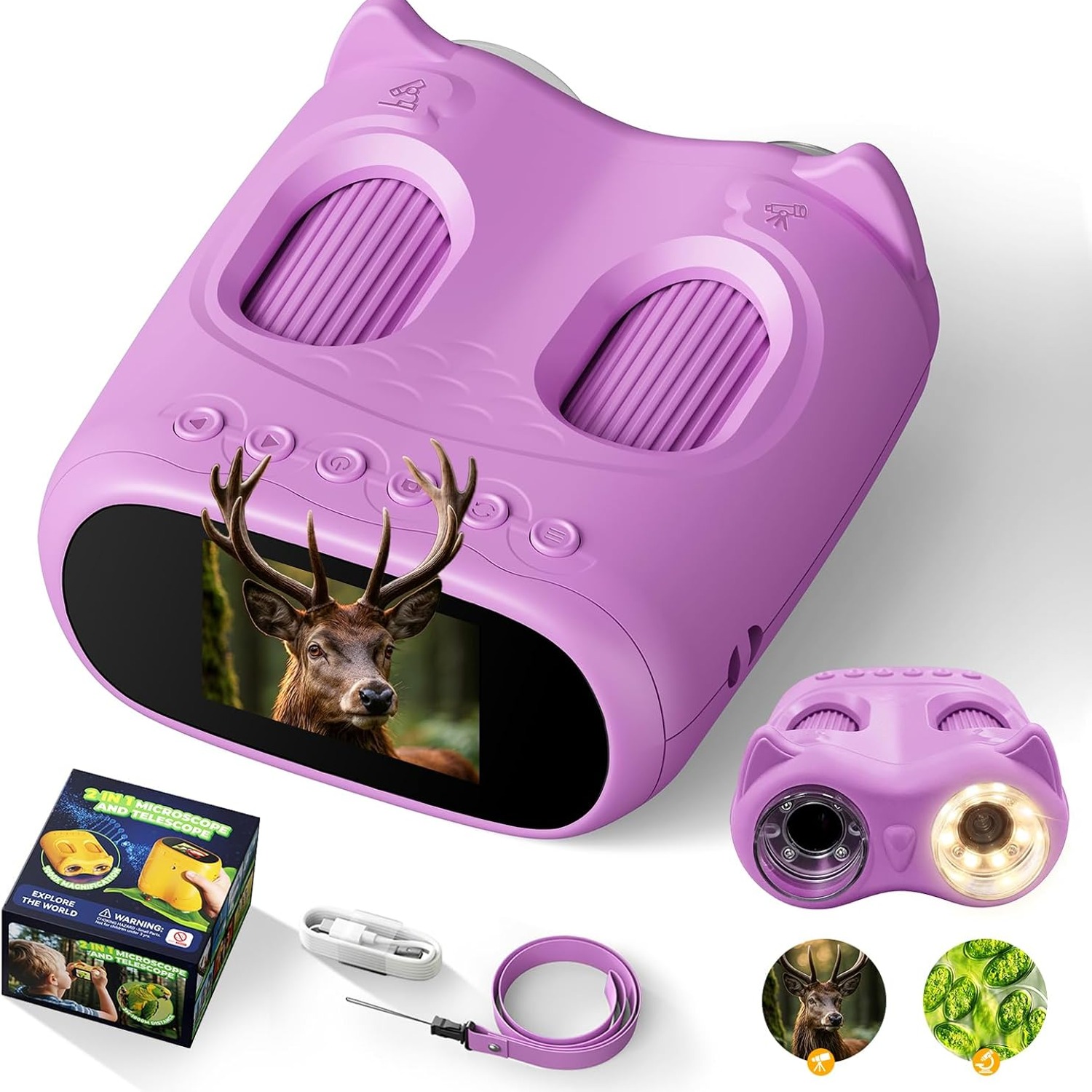
2-in-1 Kids Digital Microscope and Telescope

$83.99 $100.99 Save $17
  • Two Lenses, One Tool
  • 8 LED Lights
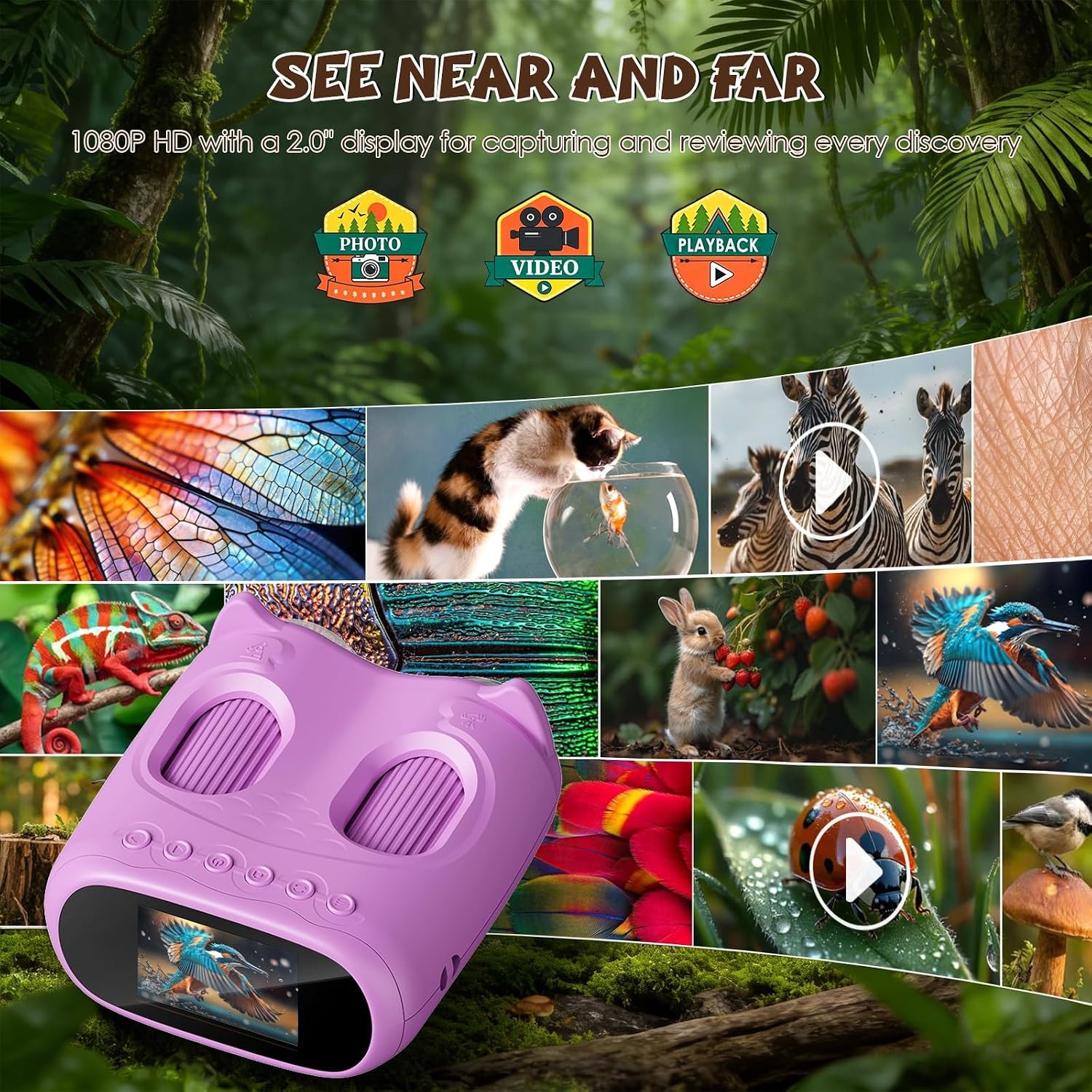
  • 1080P Photo and Video
  • USB Rechargeable

Price: $83.99 $100.99

  • Free tracked Canada-wide delivery on orders $125+, otherwise a flat $18
  • Pay by card or PayPal, handled by the payment provider
  • 14 days to change your mind, plus your statutory rights
Product specifications
BrandARNSSIEN
Model Numberinskam387
ColourPurple
Item Weight150 g
Parcel Dimensions13.1 x 12.6 x 8.2 cm
Lens ConstructionDual-use
Magnification Maximum (Stated)4 x
Light Source TypeLED
Battery1 Lithium Polymer battery (included)
Unit Count1
Country Of OriginChina
Warranty90 days
Weight150 g
Shipping & returns

Tracked delivery anywhere in Canada. It is free on orders of $125 or more, and a flat $18 below that.

If it is not right for you, send it back within 14 days of delivery in resaleable condition and we refund the price you paid, including standard delivery. That is a voluntary policy we offer on top of your legal rights. You cover the cost of returning it unless the item is faulty.

If it arrives faulty, damaged or not as described, we put it right at no cost to you under the consumer protection law of your province or territory (for example the Ontario Consumer Protection Act, 2002), return postage included.

Shipping details · Refunds and returns

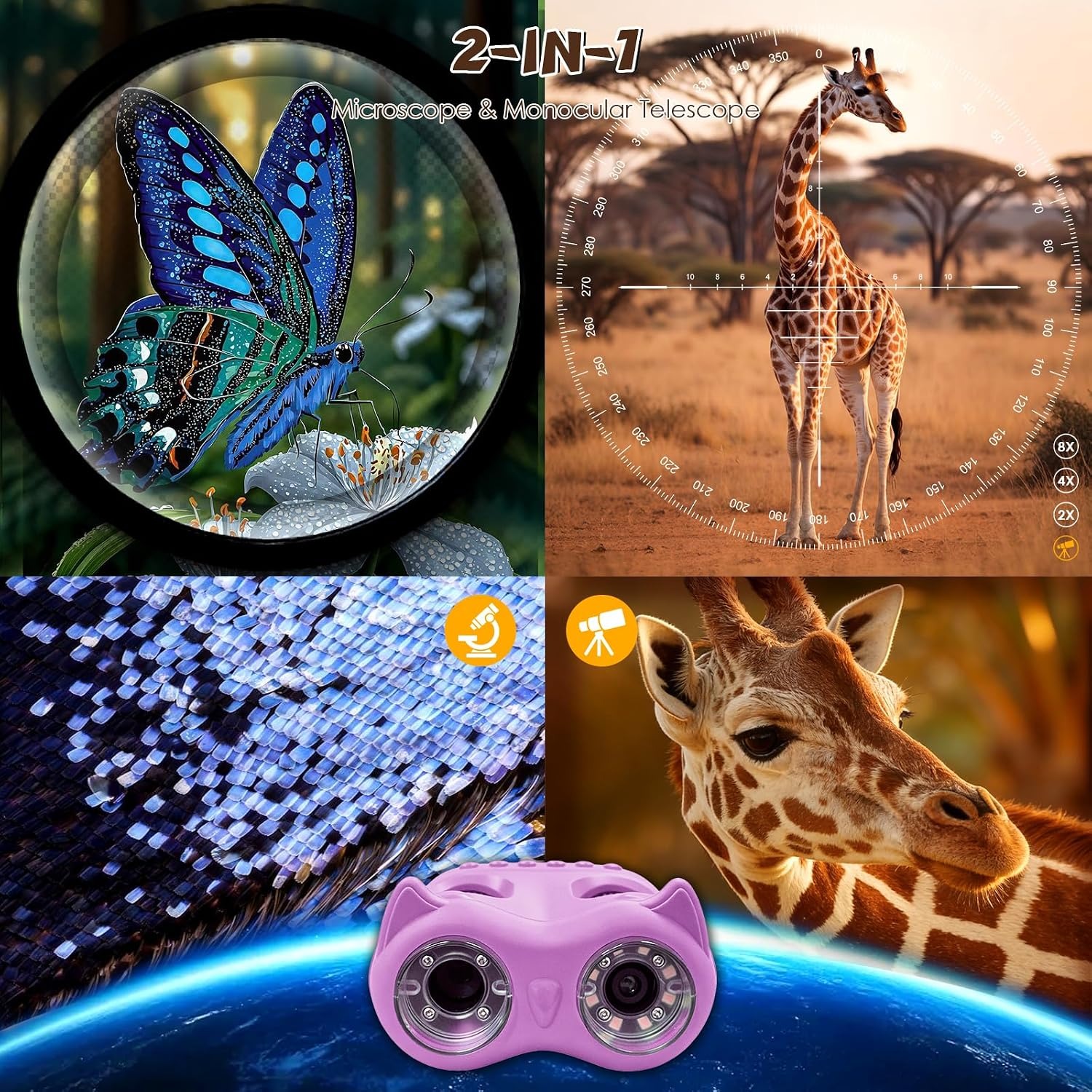
Two Lenses, One ToolSwitch between close-up microscope viewing and distance telescope viewing without swapping devices.
8 LED LightsThree brightness levels help bring out detail on dark or textured subjects.
1080P Photo and VideoSave discoveries to a TF card (up to 128GB, card not included) for school projects.
USB RechargeableBuilt-in lithium polymer battery with auto power-off after 15 minutes idle.

A kids microscope and telescope in one pocket-sized tool, built for the child who wants to look at everything twice.

Dual lenses, 8 LED lights with three brightness levels, a rechargeable battery and 1080P photo and video capture, all in a 150 g body a small hand can hold.

A 2-in-1 kids microscope and telescope that lets children study insects, leaves and fabric up close, then turn around and look at birds or rooftops in the distance.

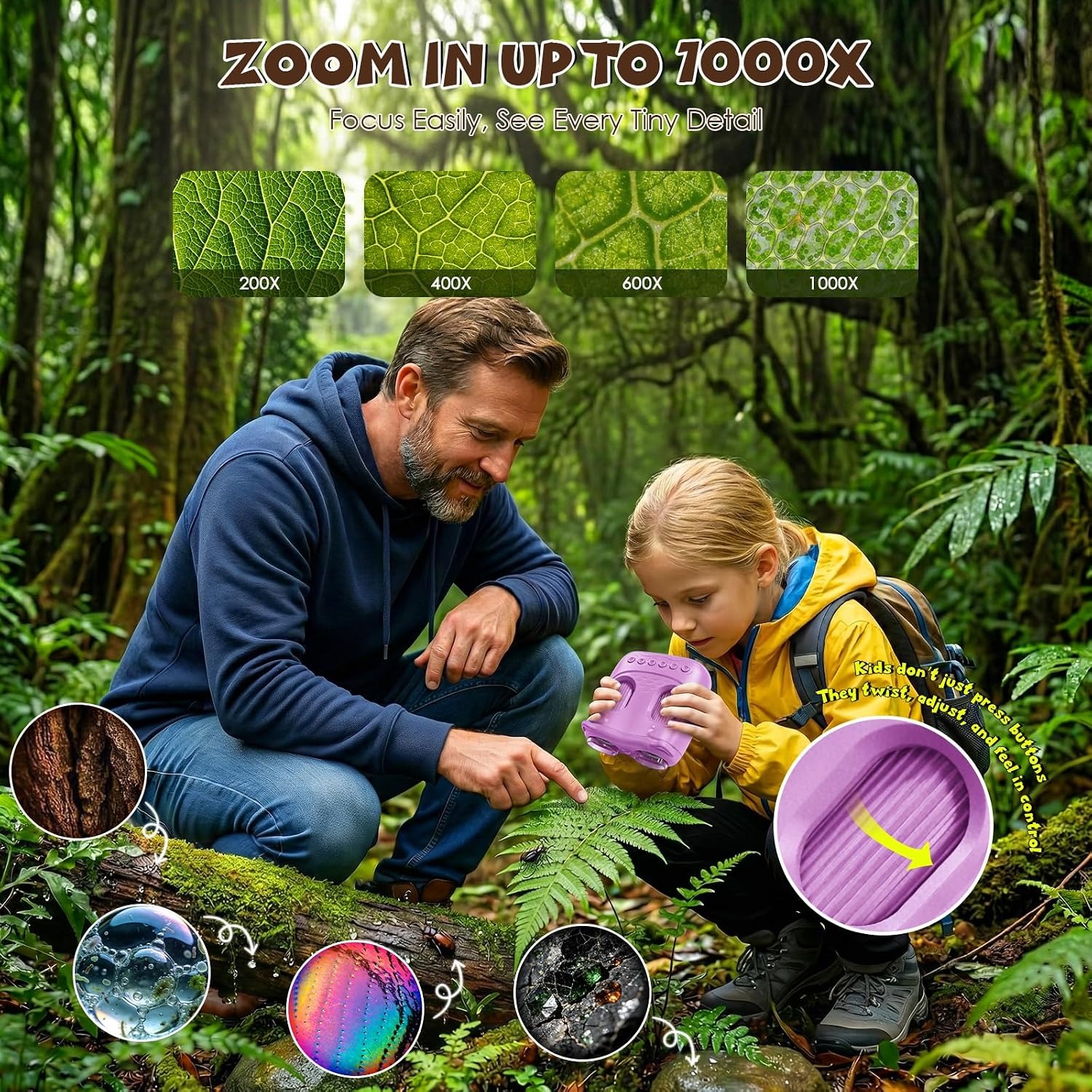
Eight LED lights with three brightness settings and a rotating focus wheel make it easy for a child to get a clear picture on their own.

Records 1080P photos and video to an external TF card of up to 128GB, so discoveries can be saved, shared or dropped into a school assignment.

Weighs just 150 g, charges over USB-C and includes a lanyard, which makes it genuinely pocketable for walks, holidays and the backyard.

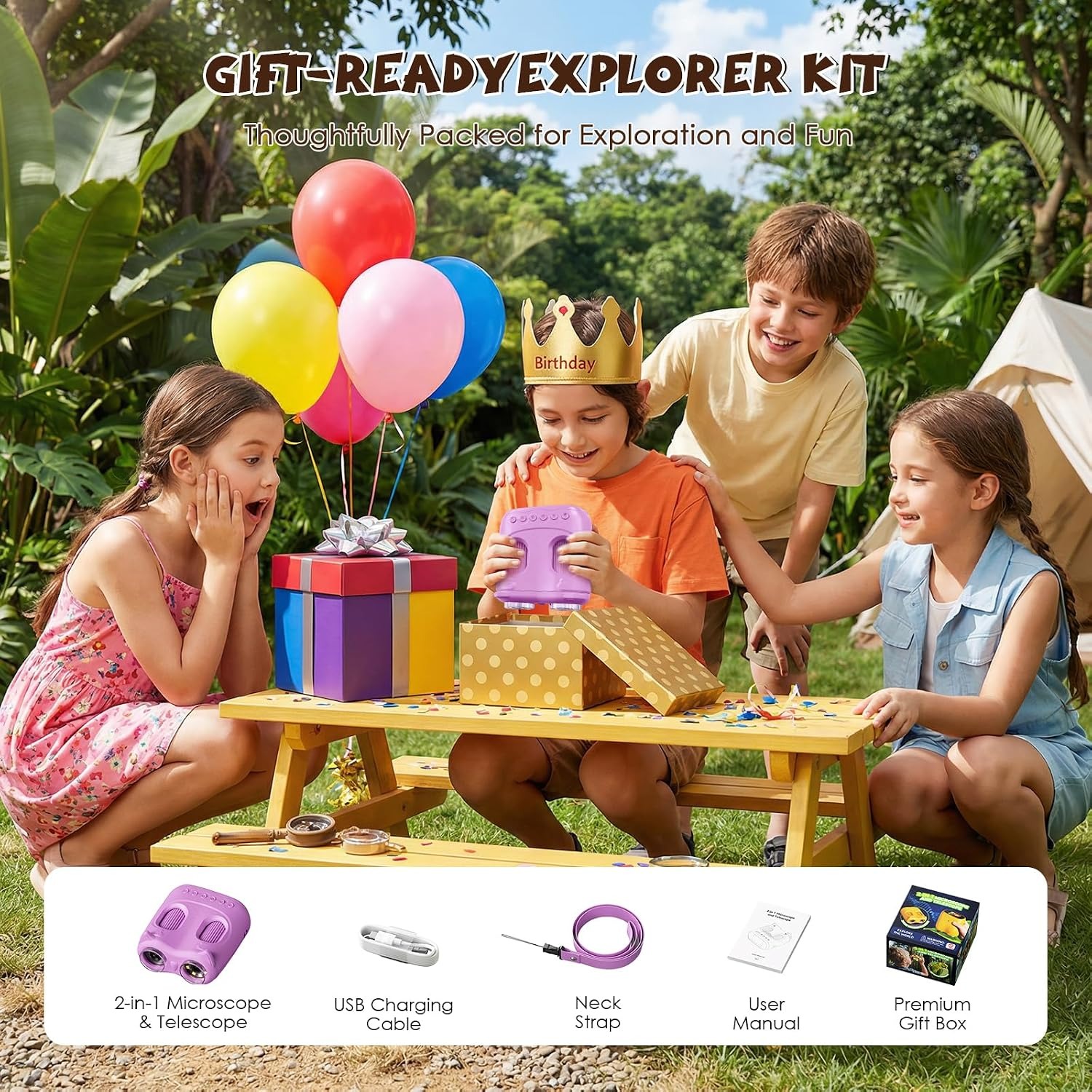
Arrives in a present box, making it an easy birthday or holiday gift for curious children aged roughly 3 to 12.

2-in-1 Kids Digital Microscope and Telescope

Most children do not need to be taught curiosity. They need something that rewards it. This handheld digital microscope does that in a pretty direct way, because the moment a child puts it over a leaf or the back of their own hand, the view changes completely. Skin becomes a landscape. A petal turns into a grid of cells and veins. That first reaction is usually what sells a child on science, and it happens in about four seconds.

2-in-1 Kids Digital Microscope and Telescope

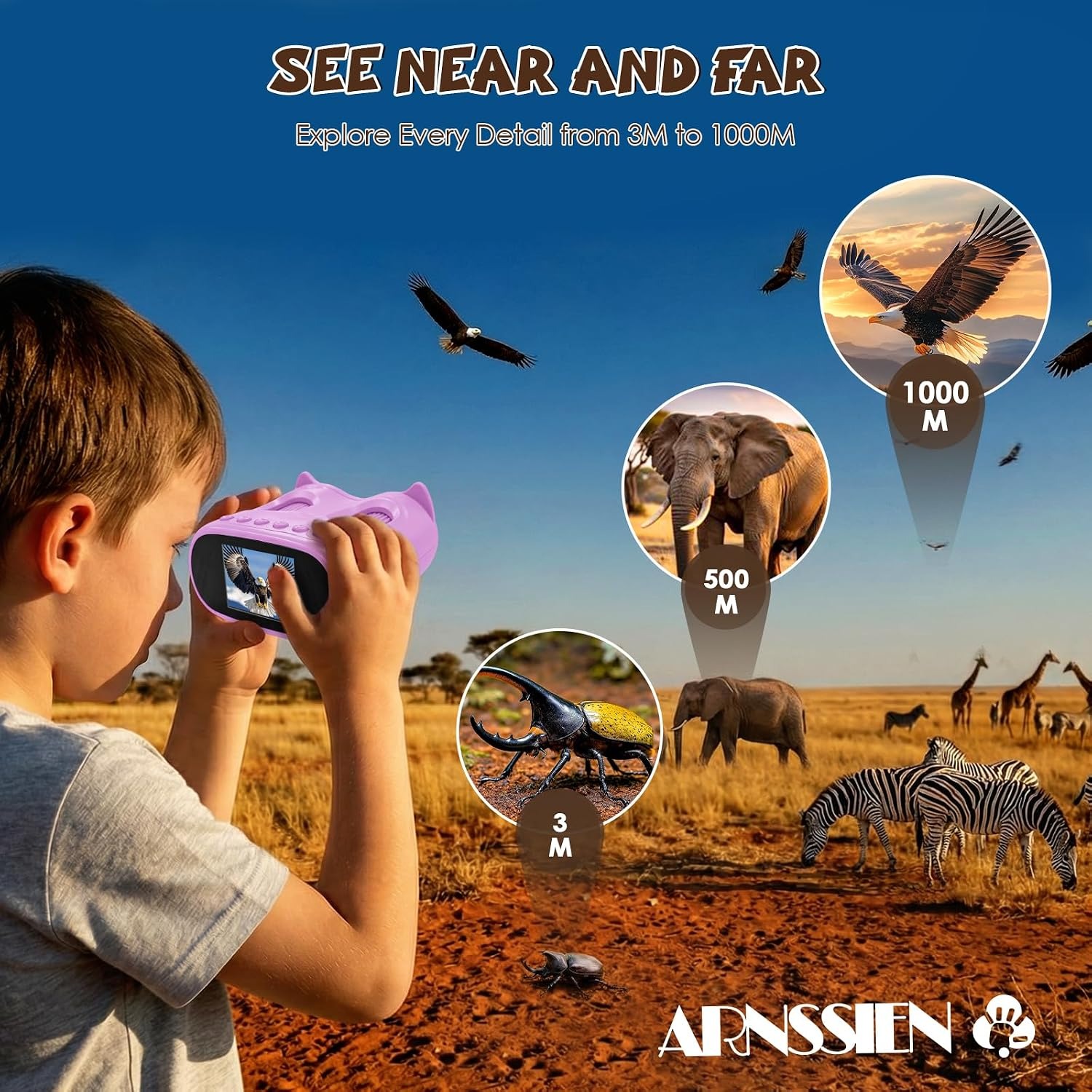
The design is deliberately simple. There are two lenses built into one purple body, so a child can study something tiny in the kitchen and then take the same device outside to look at a distant tree or a bird on a wire. No swapping parts, no separate carry case, nothing small to lose on a walk. The telescope lens needs a viewing distance of at least three metres to focus properly, which is worth explaining to a child before the first outing so there is no confusion indoors.

2-in-1 Kids Digital Microscope and Telescope

Lighting matters more than people expect with close-up viewing. Eight LEDs ring the lens and run at three brightness levels, which means a child can soften the light for something pale and shiny, or push it up for a dark pebble or a piece of bark. Paired with the rotating focus wheel, it gives a surprisingly usable picture without an adult hovering over the controls.

2-in-1 Kids Digital Microscope and Telescope

Anything worth seeing is worth keeping, so the unit records 1080P photos and video to an external TF card of up to 128GB (the card is not included). Files move to a Windows computer over USB-C, and the device also supports TF card reading mode for direct file management. That turns a toy into a research tool for a school project, a nature journal or a holiday diary.

2-in-1 Kids Digital Microscope and Telescope

At 150 g with a lanyard in the box, it travels easily. The built-in lithium polymer battery charges over USB and the unit powers down on its own after fifteen minutes of inactivity, which saves a lot of flat batteries on Sunday mornings. It ships in a present box, so it works as a gift without any extra wrapping effort.

Not sure yet? That is fine.

A toy has to suit the child it is for, and you cannot always judge that from a photograph. If it is not right for you, send it back within 14 days of delivery in resaleable condition and we refund the price you paid, including standard delivery. That is a voluntary policy we offer on top of your legal rights.

If it turns up faulty, damaged or not as described, that is on us. The consumer protection law of your province or territory covers you, and we pay the return postage. Read the full detail on our refunds and returns page, or ask us anything before you order.

Frequently Asked Questions

What exactly is this product?

It is a 2-in-1 handheld digital microscope and telescope for children, model inskam387 from ARNSSIEN. One body holds both a close-up lens and a distance lens, so a child can study a beetle and then look at a treetop with the same tool. It records photos and video at 1080P.

What age is it suitable for?

The manufacturer positions it for children aged 3 to 12. Younger children in that range will usually want an adult nearby for the first few sessions, mostly to help with focusing. By around six or seven most kids run it unassisted.

How does the microscope side actually work?

You hold the lens close to the object, turn on the LED ring, and adjust the rotating focus wheel until the picture sharpens on the screen. Because it is digital, the child sees the image on a display rather than squinting through an eyepiece. That makes it much easier for small children than a traditional lab microscope.

How does the telescope side work?

You switch to the second lens and point it at something at least three metres away. Anything closer than that will not come into focus, which catches a lot of people out on the first try. Outdoors it is handy for birds, distant trees and rooftops.

What is the stated magnification?

The product details list a magnification maximum of 4 x. The maker's details also references a 1000x figure in its marketing, but the structured product record states 4 x, so we quote the record. If exact magnification is critical to you, treat the listed 4 x as the verified figure.

Does it come with a memory card?

No. It supports external TF cards up to 128GB, but the card is not included. Any standard TF card within that capacity should work, and you only need one if you want to save photos and video.

Can I get the photos onto a computer?

Yes. Connect the device to a Windows computer with a USB-C cable to transfer files. It also supports TF card reading mode so you can manage files directly.

How is it powered?

It uses one built-in lithium polymer battery, which is included, and charges over USB. There are no disposable batteries to buy or replace. It switches itself off after fifteen minutes of inactivity to preserve charge.

How long does the battery last?

The maker does not publish a runtime figure, so we will not invent one. In practice, the automatic shutdown after fifteen minutes idle does a lot of the work in stretching a charge across several sessions. Charge it fully before a day out.

How bright are the LEDs?

There are eight LEDs around the lens with three selectable brightness levels. The lowest setting suits pale or reflective subjects, the highest helps with dark surfaces like bark, soil or stone.

Is it heavy for a child to hold?

No. The item weight is 150 g, which is about the same as a small apple. A lanyard is included so it can hang around the neck between uses rather than being put down and forgotten in the grass.

What colour is it?

Purple. That is the colour listed in the maker's details for this model.

What is in the box?

The device with its camera body and accessories, plus a lanyard, in a present box. A TF card is not included. Exact accessory contents can vary by batch, so check the packaging on arrival.

Is this a good first science tool?

It is one of the easier entry points, yes. Many parents looking for the best beginner microscope want something a child can operate without a lab setup, slides or constant supervision, and a digital handheld unit removes most of those hurdles.

Can it be used for school projects?

That is one of its more practical uses. A child can photograph a specimen, save the file to a TF card and move it to a Windows computer to drop into a report. For anyone hunting the best digital microscope for school projects, the ability to capture stills and video matters more than raw magnification.

What sort of things can my child look at?

Leaves, petals, insect wings, fabric weave, coins, sand grains, hair, skin, paper fibres and food textures all look dramatic up close. Outdoors the telescope lens handles birds, distant plants and landscape features. Half the fun is simply going around the house pointing it at things.

Does it need to be connected to a phone?

No. It is a self-contained handheld device with its own display and storage, which is part of the appeal for parents who want a screen-free learning toy that does not require handing over a phone.

Can two children share it?

Yes, though only one can look at a time. Because the image appears on a display rather than through an eyepiece, siblings can crowd around and see roughly the same thing, which works better than a traditional microscope for group use.

Is it waterproof?

No, and nothing in the maker's details suggests any water resistance. Keep it away from puddles, rain and sinks. If your child wants to look at pond life, bring the sample to the device rather than the device to the pond.

How do I clean it?

Wipe the body with a soft, dry or barely damp cloth. For the lenses, use a dedicated lens cloth or a soft blower and avoid touching the glass with bare fingers, since skin oils degrade image quality quickly.

What if the image looks blurry?

Start with the focus wheel and work slowly through its range. If you are using the telescope lens, check you are at least three metres from your subject. Also check the lens is clean, as a fingerprint is the most common cause of a soft picture.

Does it make noise or need an app?

There is no app requirement and no speaker function described in the maker's details. It is a standalone device operated with physical buttons and a focus wheel.

Is it a good gift?

It ships in a present box, which saves you wrapping it, and it suits birthdays and holidays for children in the 3 to 12 range. Parents searching for the best birthday present for budding scientists often want something that gets used more than once, and this gets dragged out on every walk.

Is it suitable for travel?

Yes. At 150 g with a lanyard and a parcel footprint of 13.1 x 12.6 x 8.2 cm, it fits in a day bag easily. It is one of the more practical portable microscopes for travel simply because there is nothing to assemble.

Does it work in low light?

The eight LEDs are there for exactly that. Indoor evening use is fine for the microscope side. The telescope lens relies on ambient light, so it works best during daylight.

What is the warranty?

The warranty description listed by the manufacturer is 90 days. Keep your order confirmation, as it is usually all that is needed to start a claim.

Where is it made?

The country of origin is China. The manufacturer listed is Shenzhen Nuotong Aesthetic Technology Co., Ltd.

How long does delivery take?

We deliver to addresses across Canada with a tracked courier. Most orders arrive within 5 to 10 working days of the order date, including one working day of handling. Delivery is free on orders of $125 or more and a flat $18 under that.

What is your returns policy?

Change of mind returns are accepted within 14 days of delivery for unused items in their original packaging, with the buyer paying return postage. Get in touch before sending anything back so we can give you the return details. A faulty or damaged item is put right at our cost.

What if it is not right for my child?

Get in touch and tell us what went wrong, whether it was too advanced, too simple or just not what you pictured. If it is still within 14 days of delivery and in resalable condition we will walk you through sending it back, and if the issue looks like a fault we will raise it under the 90 day warranty instead. Either way, you are not stuck with a device your child will not use.

How to Choose a Kids Microscope and Telescope That Gets Used More Than Twice

6 min read Toy Warehouse

The toy that ends up in the cupboard

Most science gifts fail in the same way. They arrive, they get a big reaction, and within two weeks they are at the back of a shelf with a missing part. It is rarely because the child lost interest in science. It is because the thing was fiddly, or it needed slides, or the picture never quite came into focus, or someone had to set it up every single time.

A traditional lab-style microscope is a good example. It is excellent equipment, but it asks a lot. You need a flat surface, decent lighting, prepared slides, a steady hand and the patience to line up an eyepiece with one eye closed. A six year old has about ninety seconds of patience for that sequence. After that, they wander off.

A handheld digital microscope flips the problem. Instead of bringing the specimen to the lab, you bring the lens to the specimen. The child points it at a leaf still attached to the plant, or at the carpet, or at their own fingernail, and the image shows up on a display they can look at with both eyes open. No setup. No slides. No waiting.

What this one actually does

The ARNSSIEN inskam387 is a two-lens device. One lens handles close-up work, the other handles distance. That second lens is the part people underestimate, because it means the same tool covers a kitchen table session and a walk in the park. You are not carrying two things, and you are not choosing between them when you pack a bag.

Eight LEDs ring the close-up lens, with three brightness levels. This sounds like a small detail and it is not. Close-up viewing eats light. When you put a lens almost against a surface, the lens itself blocks most of the available light, which is why a plain magnifying glass often shows you a dark blur. The LED ring solves that, and having three levels means a child can dial it down for shiny subjects that would otherwise wash out.

Focus is handled by a rotating wheel. It is one control, it turns in two directions, and children work it out fast. That single design decision is probably the biggest reason this style of device stays in use longer than a traditional scope.

Capture runs at 1080P for both photos and video, stored on an external TF card up to 128GB. The card is not included, which is worth knowing before the gift is opened. Files transfer to a Windows computer over USB-C, and the device supports TF card reading mode for direct file management.

Power comes from a built-in lithium polymer battery charged by USB, with automatic shutdown after fifteen minutes of inactivity. The whole unit weighs 150 g and comes with a lanyard.

Who it suits

The manufacturer targets ages 3 to 12, which is a wide band, and the experience really does change across it.

At three or four, a child is not conducting investigations. They are reacting. They point it at things and say "whoa". That is a completely valid use and it builds the habit of looking closely, which is the foundation of everything else. Expect to help with focusing at this age.

Between five and eight, something shifts. Children start choosing what to look at on purpose. They compare two leaves. They check whether their sister's hair looks different from theirs. This is the sweet spot, and it is where a tool like this gets used almost daily for a while.

From nine to twelve, the capture function becomes the point. School projects need images, and a child who can produce their own photographs of a specimen, rather than pulling one off the internet, tends to be a bit prouder of the work. For anyone comparing options for the best kids science kit at this age, the ability to save and transfer files is the feature that matters most.

Children who are reluctant readers or who struggle to sit still for schoolwork often do unusually well with this kind of tool. It rewards movement and curiosity rather than stillness and patience.

How to choose between devices like this

A few things are worth checking whenever you compare handheld units.

Lighting is first. If a close-up device has no built-in light, or only one brightness setting, the picture quality drops hard on dark subjects. Eight LEDs with three levels is a reasonable spec at this price.

Storage is second. Some devices show you an image and that is it. Being able to save a photo turns the toy into something a child can build on, and it gives you a record of what they found. Just remember to buy the TF card separately.

Weight and shape come third, and they decide whether the thing ever leaves the house. At 150 g with a lanyard, this one travels. A heavier unit with a separate stand and a mains cable does not, no matter how good the optics are.

Then there is the question of how a child charges and starts it. USB charging beats disposable batteries for a kids device, partly on cost and partly because nothing kills enthusiasm faster than discovering you have no AAs at eight on a Saturday morning.

Finally, be realistic about specifications. Supplier marketing for this category is noisy, with big magnification numbers quoted in headlines. The structured product record for this model states a magnification maximum of 4 x. We would rather tell you that plainly than repeat a bigger number we cannot verify. In practice, the useful question is not "how many times" but "can my child get a clear, well-lit picture of a leaf", and a lit handheld lens with a focus wheel does that comfortably.

The one rule to explain on day one

The telescope lens needs a viewing distance of at least three metres. Anything closer will not focus, full stop.

Tell your child this before they unbox it, because the very first instinct is to point the telescope side at something on the table, see nothing, and decide the device is broken. Ten seconds of explanation prevents a lot of disappointment. Go outside, pick a tree at the end of the garden, and start there.

Looking after it

The lenses are the only fragile part in daily use, and the main threat is fingers. Skin oils smear optical surfaces and are surprisingly hard to clean off properly. Teach the habit early of holding the body, never the glass. A soft lens cloth or a puff of air from a blower handles dust.

For the body, a soft dry cloth is enough. A barely damp cloth is fine for sticky marks, but keep water away from the lens housing, the charging port and the card slot. There is no water resistance described for this product, so treat it as a dry-use device.

Store it in its box between adventures. It is small enough that it disappears into sofas and toy boxes otherwise, and the box also keeps dust off the lenses.

Charge it every couple of months even if it is not being used. Lithium batteries that sit completely flat for a long time do not age well.

The short version

If you want a science gift that survives past the first week, look for something a child can pick up and use alone, in any room, without preparation. That is the whole argument for a handheld digital microscope over a traditional one.

This model adds a second lens for distance viewing, eight LEDs with three brightness levels, 1080P capture to a TF card you supply, USB charging and a 150 g body with a lanyard. It arrives in a present box with a 90 day warranty.

Buy a TF card at the same time, explain the three metre rule before the first outing, and teach the no-fingers-on-the-lens habit in week one. Do those three things and you have given a child a tool rather than a toy.

Browse the shop

Ready to hand over the magnifier?

Order the 2-in-1 kids microscope and telescope today and give your child a tool that makes ordinary things look extraordinary.

Ask us a question

Page summary

The ARNSSIEN inskam387 is a 2-in-1 kids microscope and telescope aimed at children roughly 3 to 12 years old. It has a dual-use lens construction for close-up and distance viewing, 8 LED lights with three brightness levels, a rotating focus wheel, and 1080P photo and video recording to an external TF card of up to 128GB (card not included). Files transfer to a Windows computer via USB-C, and the device supports TF card reading mode. It weighs 150 g, is purple, runs on an included lithium polymer battery charged by USB, and powers off after 15 minutes idle. The telescope lens needs a viewing distance of at least 3 metres. Made in China, warranty 90 days. Material is not specified by the maker.