

The complete guide
The Honest Buyer's Guide to Wooden Tangram Sets
The problem with most "educational" toys
Walk through any toy aisle and you will find shelves of things that claim to teach something. Most of them do it once. The child works out the trick, the novelty fades, and the box goes to the back of the cupboard by the second week. The batteries die and nobody replaces them.
A wooden tangram set has the opposite problem, in a good way. It looks almost too simple. Seven flat wooden pieces and a stack of cards. There is nothing to switch on and no sound effects. And yet it is the kind of thing children keep coming back to, because the difficulty is set by the child rather than the toy. A four year old lays pieces onto a picture. An eight year old works from the outline alone and times herself. A grandparent gets quietly stuck on a card and will not admit it.
That flexibility is the whole case for a tangram. One box, one price, and it stays useful for years instead of weeks.
How a tangram actually works
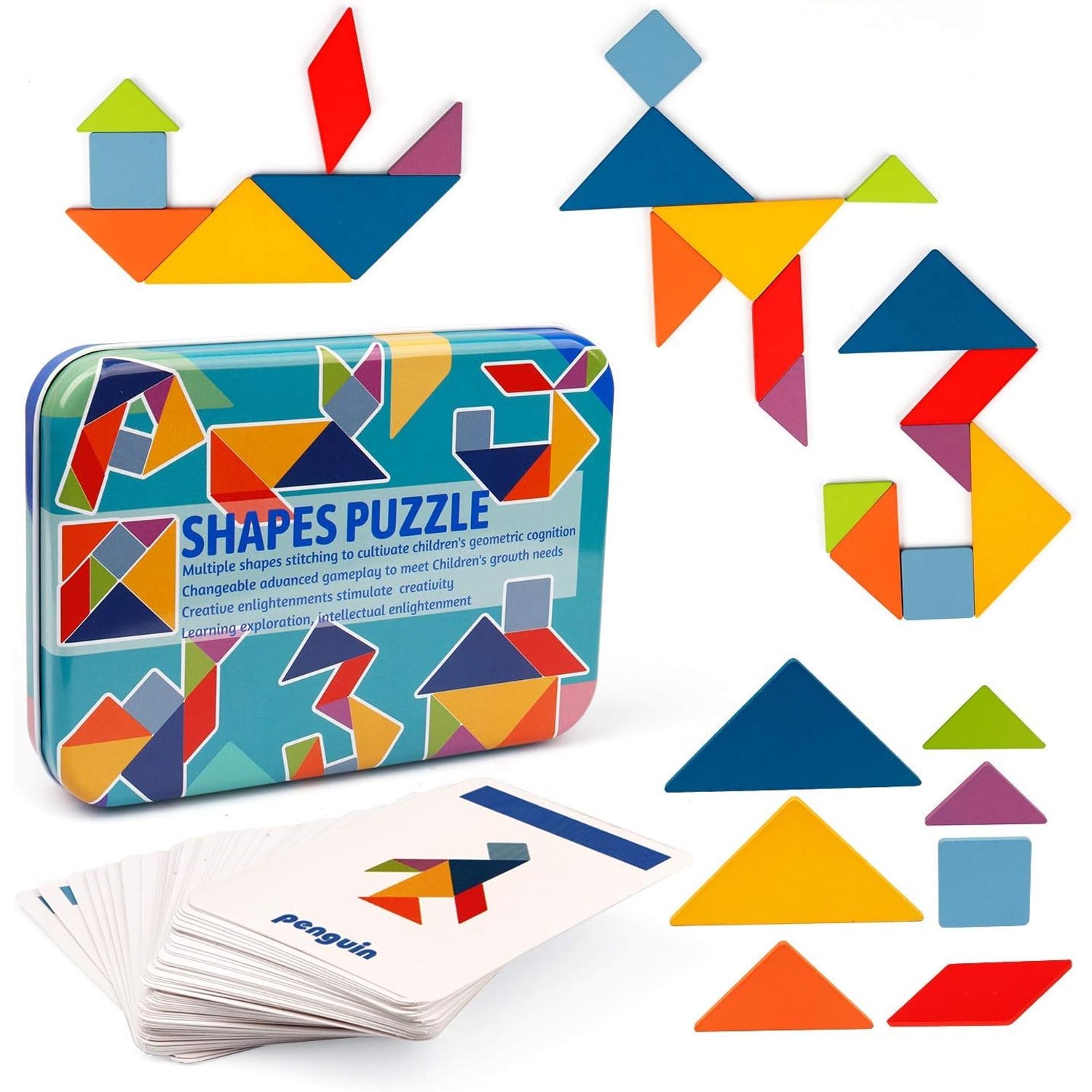
The tangram comes from China and has been around for centuries. The full set is a square cut into seven pieces: two large triangles, one medium triangle, two small triangles, a square and a parallelogram. Those seven pieces are called tans.
The rule is simple. Use all seven pieces, lay them flat, do not overlap them, and match the shape you are aiming at. Pieces can be rotated and flipped freely. That is it.
What makes it absorbing is that the same seven pieces produce wildly different results depending on how you turn them. A shape that looks obvious at a glance will refuse to come together for ten minutes, and then one rotation makes the whole thing click. That click is why children stay with it.
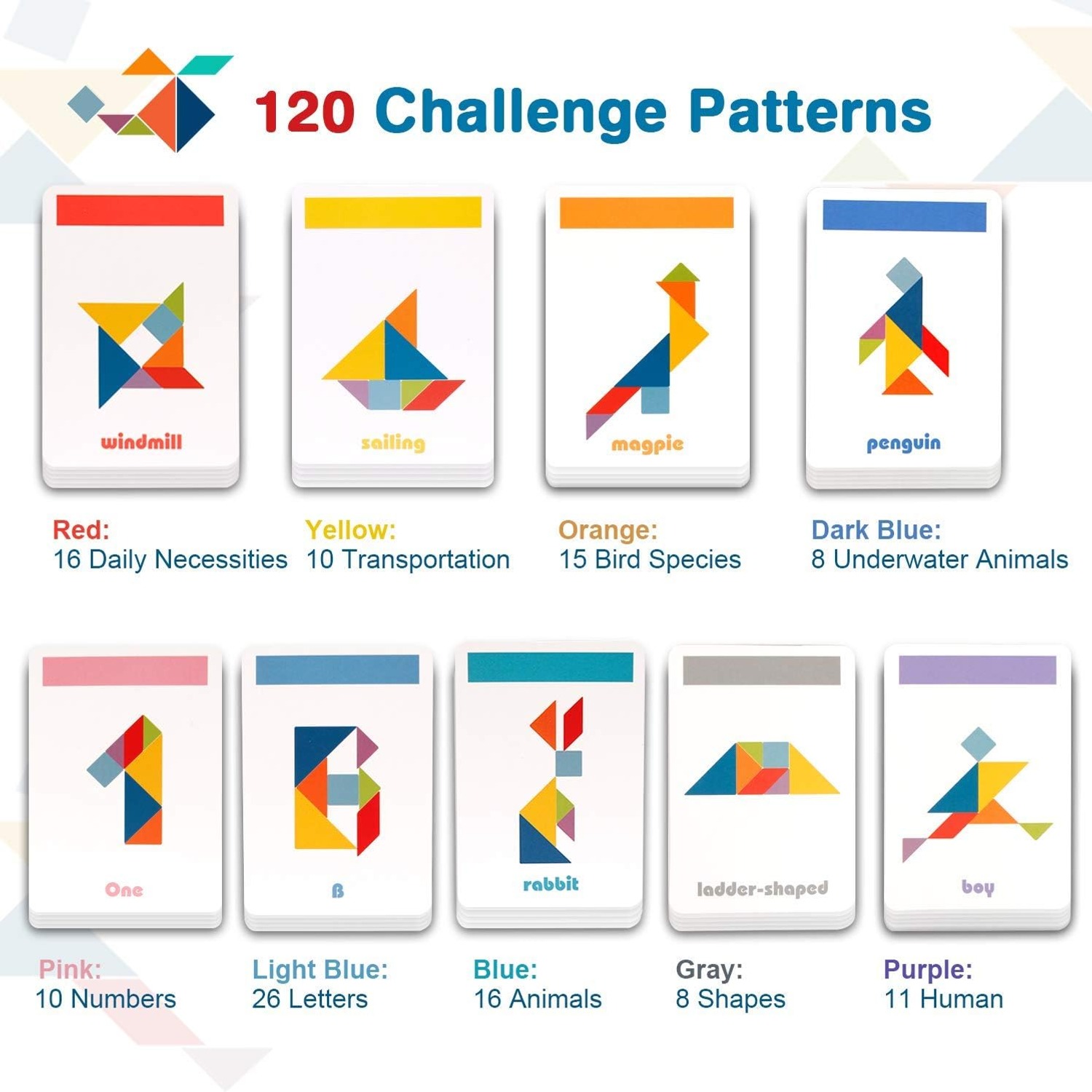
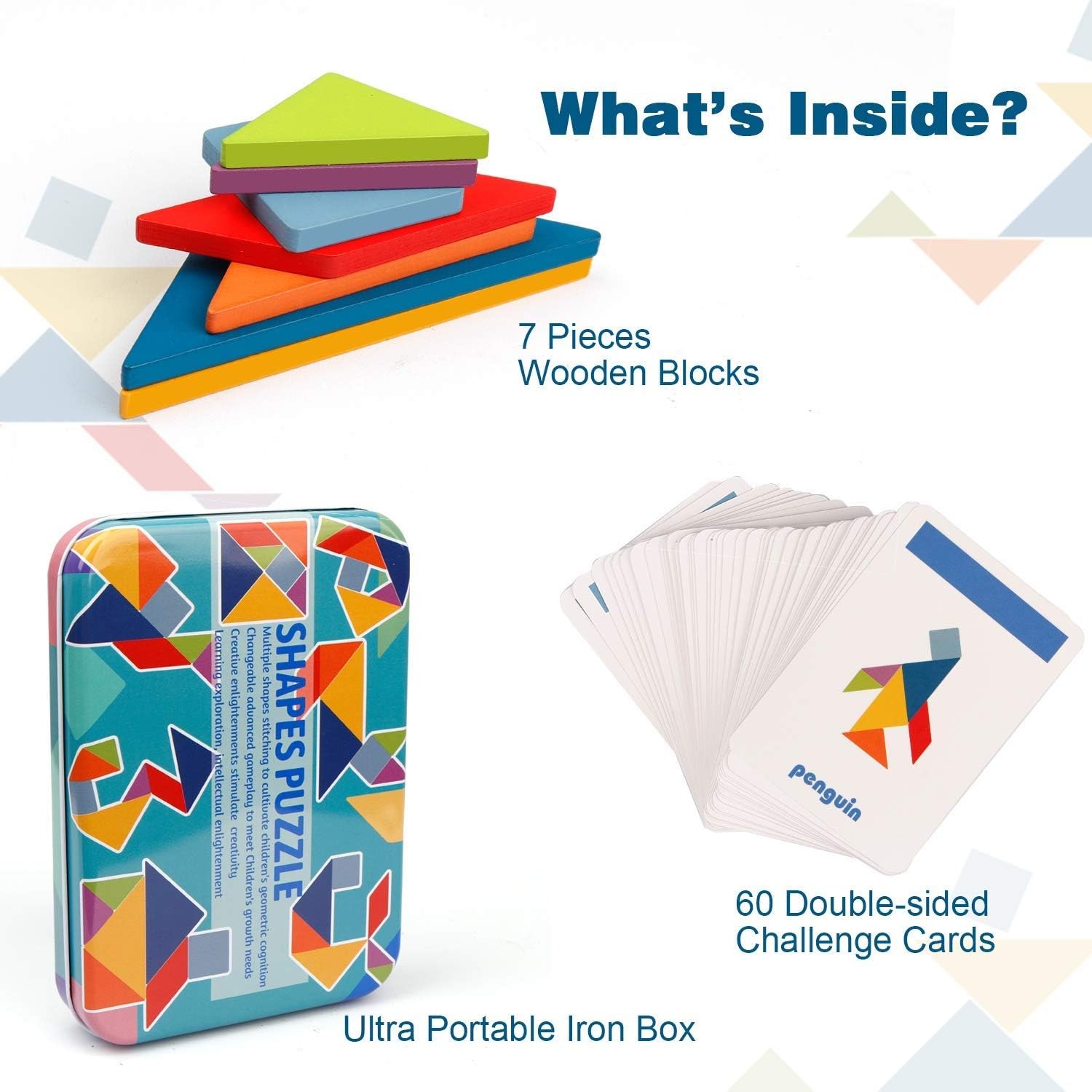
This Vanmor set supplies the seven tans in wood, finished in several colours, along with 60 double-sided pattern cards. The cards show animals, vehicles, letters and numbers. Double-sided printing means 120 printed challenges without a thick deck to carry.
What the cards add
A plain tangram with no cards is a fine toy, but young children often do not know where to start. The card pack solves that. It gives a target.
The card mix also quietly broadens what the set teaches. Building a rabbit is pure shape work. Building the letter K links shape work to the alphabet. Building the number 4 links it to counting. You can run the cards as flashcards first, naming each one aloud, then build them. That turns a solo puzzle into a shared game with very little effort from the adult.
Cards also make the difficulty adjustable. Sort them into easy and hard piles after the first week and you have a rough levelling system. Hand over an easy one when a child is tired and a hard one when they are looking for a fight.
Who it suits
The manufacturer recommends ages 36 months to 12 years, and that range is realistic rather than optimistic.
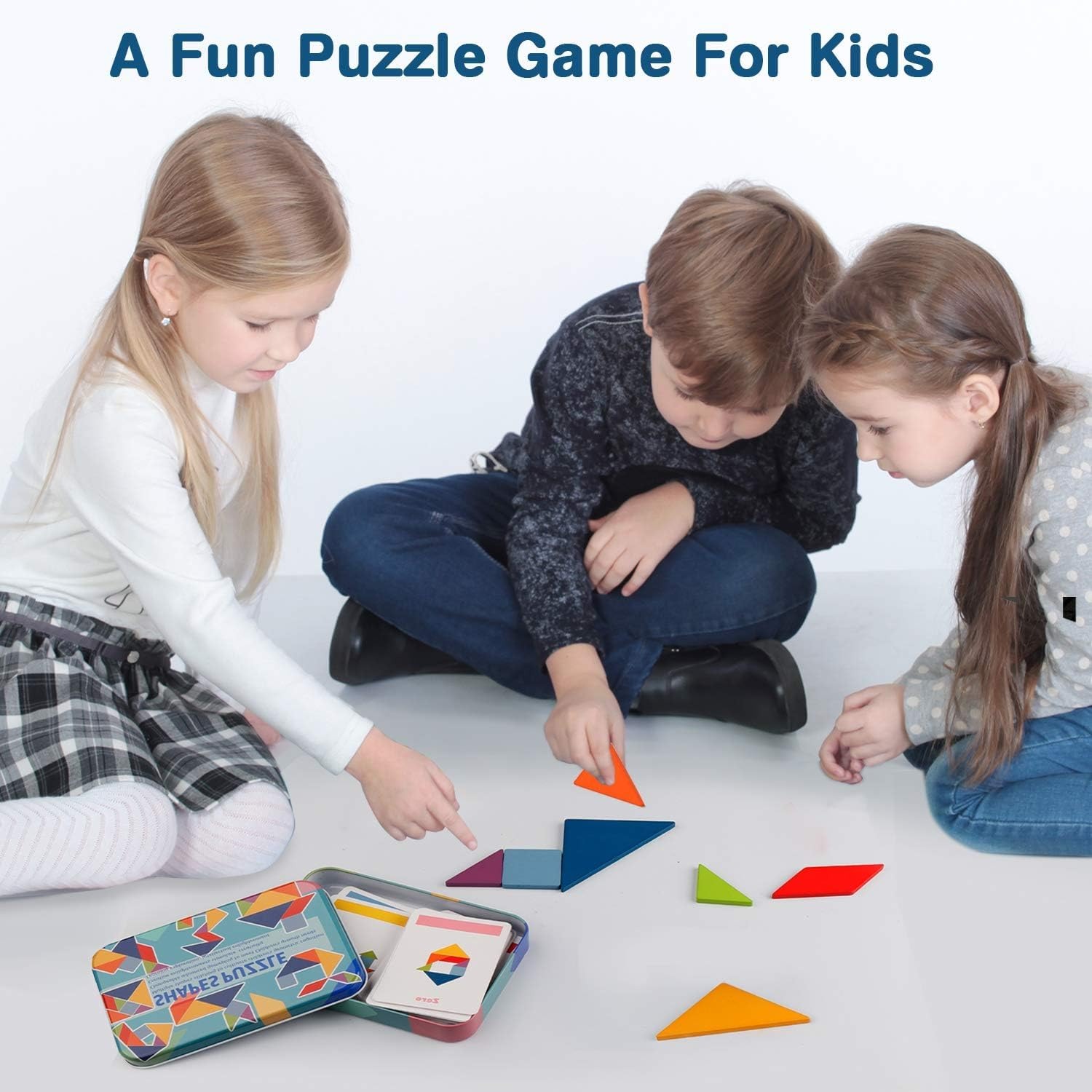
Three and four year olds mostly do free building and direct matching. They will put a triangle on the picture and be delighted. This stage is about handling the pieces and noticing that shapes have different sizes.
Five to seven is the sweet spot. Children at this age can work from an outline, hold the target shape in their head, and feel genuine satisfaction when it resolves. This is also where the attention span starts to stretch, and a tangram is one of the few activities that rewards sitting still.
Eight and up tends to go two ways. Some children move to speed, racing a sibling or a stopwatch. Others move to invention, making their own shapes and drawing the outlines for someone else to solve. Both are good signs.
Adults should not feel left out. The classic tangram outlines are hard, and a few will cost you a cup of coffee's worth of thinking.
How to choose a set
A few things separate a set you keep from one you quietly bin.
Piece size. Pieces that are too small are fiddly for young hands and get lost in car seats. These are described as scaled for small hands, which is the right target for the 4 to 8 bracket.
Finish. Sanded edges matter more than people expect. Rough wood snags on fingers and makes a child reluctant to handle the pieces.
Portability. This is where the Vanmor set is strong. The whole thing measures 16.7 x 12.3 x 0.1 cm and weighs 186.3 g. That is flat enough to slide beside a tablet in a bag and light enough that nobody complains about carrying it. If you specifically want the best travel puzzle for kids, weight and thickness are the two numbers to check.
Card count. Sixty double-sided cards is a solid pack. Fewer than about 30 and children exhaust it quickly.
Storage. A dedicated box is not a luxury with a seven-piece puzzle. Lose one tan and most cards become unsolvable. Any set worth buying comes with somewhere to put the pieces.
Getting the most out of it at home
Start without the cards. Let the child tip out the pieces and make whatever they like for the first session. This builds familiarity with the shapes before any pressure to match something appears.
Use a tray. A shallow tray or a baking sheet stops pieces sliding and makes cleanup a single movement. In a car it is close to essential.
Play alongside rather than over. Sitting with your own card and working on it in parallel keeps a child going far longer than watching and correcting does. If they get stuck, move one piece into place without comment and let them finish.
Count the pieces back. Seven in, lid on, every time. It takes five seconds and it is the difference between a set that lasts years and one that is dead by March.
Rotate it away. Put the box out of sight for a month when interest dips and bring it back later. It will feel new again.
Care and longevity
Wooden toys are forgiving but not indestructible. Wipe the pieces with a barely damp cloth when they get grubby, then dry them straight away. Do not soak them, do not put them in a dishwasher, and keep them out of a hot trunk for days on end. Painted wood lifts when it sits in water and warps when it gets wet and then bakes.
The cards need less fuss. Keep them dry and flat in the box. If your household is hard on paper, card sleeves or a quick lamination will see the pack through several children.
Stored sensibly, there is very little to go wrong here. There are no moving parts, no battery compartment to corrode, and no software to stop being supported.
The short version
A wooden tangram set is one of the better value purchases in children's toys, because the seven pieces do not age. The same box that entertains a four year old laying shapes on a picture will frustrate and delight the same child at nine.
This Vanmor set gives you the standard seven wooden tans, 60 double-sided pattern cards covering animals, vehicles, letters and numbers, and a portable box, all at 186.3 g and 16.7 x 12.3 x 0.1 cm. It is rated for 36 months to 12 years, it needs no power, and it works on any flat surface.
If you want something that holds attention without a screen, travels easily, and keeps earning its shelf space, this is a straightforward yes.