

Toy Warehouse
Company
Shop By Category
T&Cs
Shop Online
  • Box contents listed
  • Free tracked Canada-wide delivery over $125
  • 14-day returns

17 Key Kalimba | Thumb piano | Kalimba for beginners

17 Key Kalimba Thumb Piano

$59.99 $71.99 Save $12
  • 17 Marked Keys
  • Wooden Body
  • Travel Ready
  • Starter Kit

Price: $59.99 $71.99

  • Free tracked Canada-wide delivery on orders $125+, otherwise a flat $18
  • Pay by card or PayPal, handled by the payment provider
  • 14 days to change your mind, plus your statutory rights
Product specifications
BrandNewlam
Model NameKalimba
Model NumberCA-17B
Part NumberCA-17B
Item TypeKalimba
Number of Keys17
Body MaterialWood
ColourWood
Finish TypeUnfinished, polished, varnished or lacquered
Sound ProfileEthereal
Hand OrientationLeft or right
Included ComponentsInstruction book, flannelette bag, cleaning fabric
Item Dimensions17.98 x 12.9 x 3 cm
Item Weight327 g
Unit Count1
Number of Items1
Country of OriginChina
Warranty180 days warranty
Weight327 g
Shipping & returns

Tracked delivery anywhere in Canada. It is free on orders of $125 or more, and a flat $18 below that.

If it is not right for you, send it back within 14 days of delivery in resaleable condition and we refund the price you paid, including standard delivery. That is a voluntary policy we offer on top of your legal rights. You cover the cost of returning it unless the item is faulty.

If it arrives faulty, damaged or not as described, we put it right at no cost to you under the consumer protection law of your province or territory (for example the Ontario Consumer Protection Act, 2002), return postage included.

Shipping details · Refunds and returns

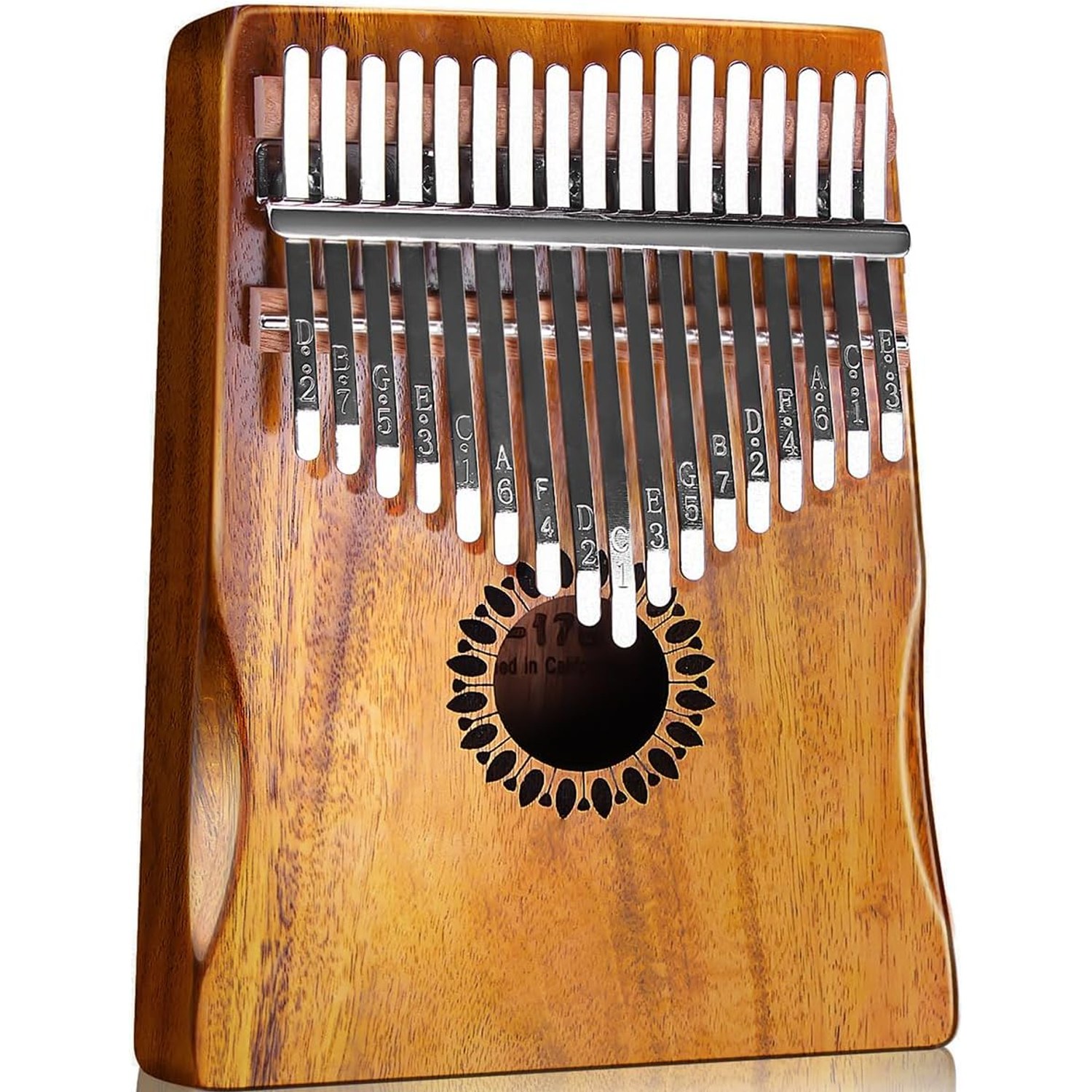
17 Marked KeysLetters and numbers are embossed on the tines, so you can follow a song without stickers.
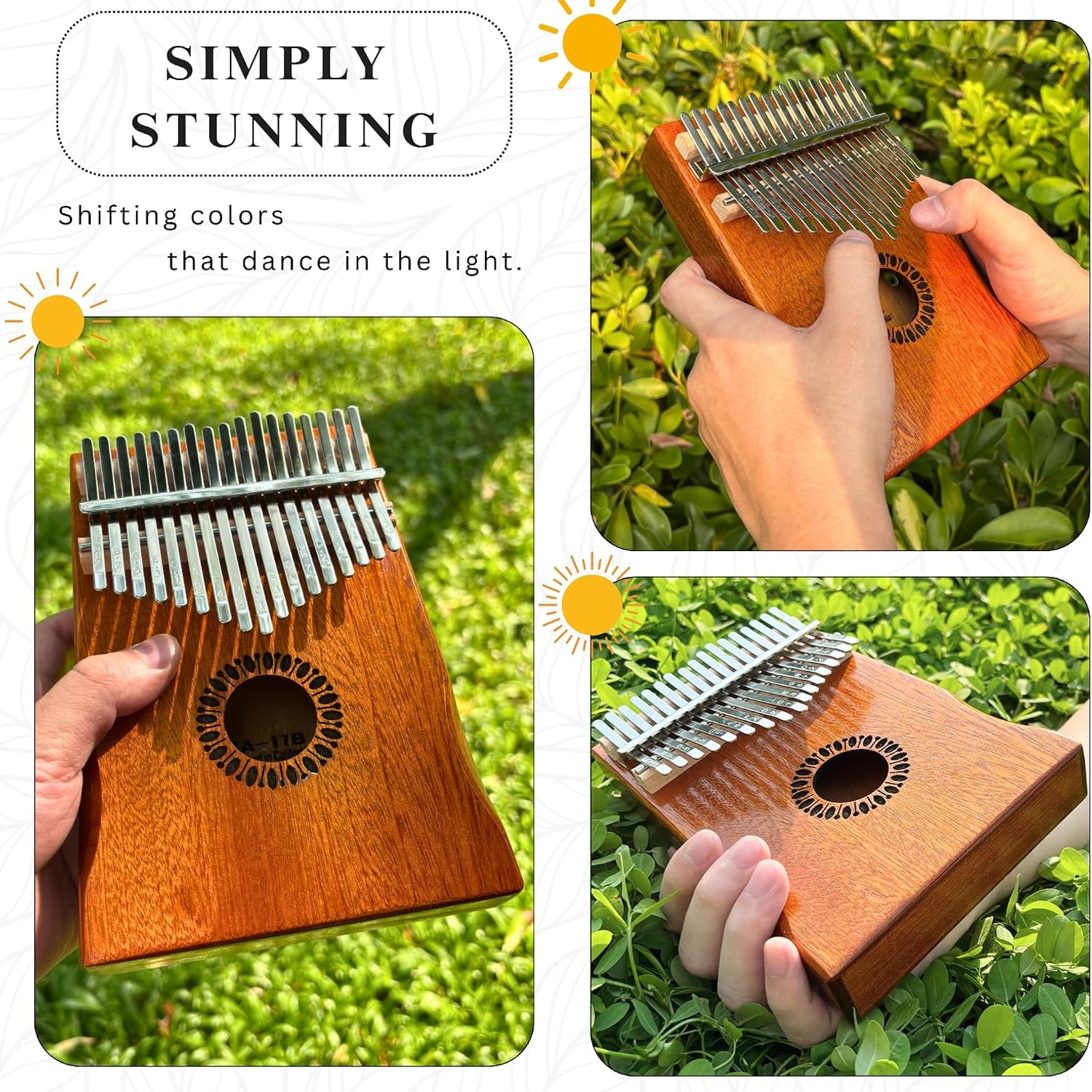
Wooden BodyA wood body paired with steel tines for a soft, bell-like tone.
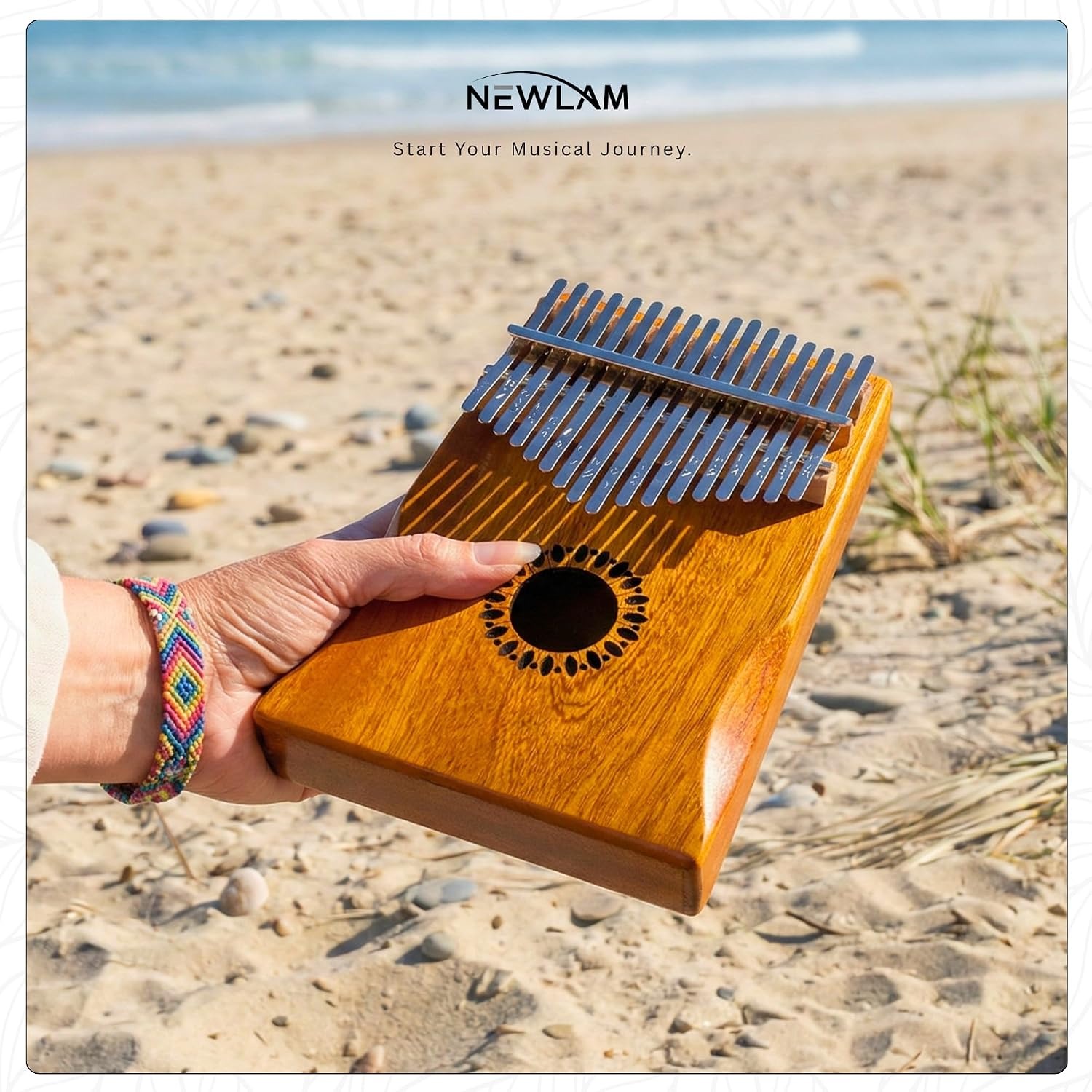
Travel ReadyComes with a flannelette bag and weighs only 327 g, so it fits in a daypack.
Starter KitInstruction book, cleaning fabric and bag are included in the box.

Pick up this 17 key kalimba and play your first simple tune the same afternoon you open the box.

A wooden thumb piano with 17 steel tines, letters and note numbers stamped straight onto the keys, a curved handrest for longer sessions, and a soft bag so it travels in a backpack.

A 17 key kalimba with a wooden body and steel tines that sounds gentle enough to play late at night without annoying the household.

Each key carries an embossed letter and number, which means a beginner can read simple tablature straight off the instrument.

The curved handrest sits against your palms so your thumbs can keep moving without the edges digging in.

At 327 g and roughly 18 cm long, it slips into a bag and travels far more easily than a guitar or keyboard.

The kit arrives with an instruction book, a flannelette bag and a cleaning fabric, so there is nothing else to buy on day one.

17 Key Kalimba Thumb Piano

The kalimba, also called a thumb piano or mbira, is one of the friendliest instruments a person can pick up. You hold it in both hands, rest your thumbs on the tines, and pluck. There are no strings to press down, no breath control to learn, no posture to correct. The sound arrives immediately, and it is a soft, rounded, bell-like tone that fills a room without shouting. That low barrier is exactly why so many adults who gave up on guitar end up loving this instrument instead.

17 Key Kalimba Thumb Piano

This Newlam model has 17 keys made from steel bars fitted to a wooden body. The tines are arranged with the longest in the middle and shorter ones alternating out to the sides, which is the standard kalimba layout. Once your thumbs learn that pattern, most beginner tablature makes sense very quickly. Each key is embossed with a letter and a number, so you are reading directly from the instrument rather than squinting at paper stickers that peel off after a few weeks.

17 Key Kalimba Thumb Piano

Comfort matters more than people expect with a small instrument, because you tend to play it for long stretches without noticing. The handrest is curved rather than square-edged, so the sides of the body sit against your palms instead of pressing into them. At 327 g the kalimba is light enough to hold up for a whole album's worth of playing, and the 17.98 x 12.9 x 3 cm footprint means it lives happily on a desk, a bedside table or a windowsill where you will actually see it and pick it up.

17 Key Kalimba Thumb Piano

The box is a complete starter set rather than a bare instrument. You get the kalimba, an instruction book to take you through the first songs, a flannelette bag for storage and travel, and a cleaning fabric for wiping fingerprints off the tines. That combination makes it a straightforward gift, since the recipient does not need to order anything extra before they can play. It is covered by a 180 days warranty.

17 Key Kalimba Thumb Piano

People buy a 17 key kalimba for all sorts of reasons. Some want a quiet hobby that does not involve a screen. Some want a small instrument for travel that fits in hand luggage. Parents buy them as a first instrument for a child, because nothing about the kalimba is intimidating and there is no wrong way to make a nice sound with it. Whatever the reason, the appeal is the same, which is that the distance between opening the box and making music is measured in minutes.

Not sure yet? That is fine.

A toy has to suit the child it is for, and you cannot always judge that from a photograph. If it is not right for you, send it back within 14 days of delivery in resaleable condition and we refund the price you paid, including standard delivery. That is a voluntary policy we offer on top of your legal rights.

If it turns up faulty, damaged or not as described, that is on us. The consumer protection law of your province or territory covers you, and we pay the return postage. Read the full detail on our refunds and returns page, or ask us anything before you order.

Frequently Asked Questions

What exactly is a kalimba?

A kalimba is a small hand-held instrument with metal tines mounted on a wooden body. You hold it in both hands and pluck the tines with your thumbs, which is why it is also called a thumb piano. It comes from a long African tradition of lamellophone instruments.

How many keys does this one have?

This model has 17 keys, which is the most common size and the one most beginner tablature is written for. Seventeen tines give you enough range for a lot of well-known melodies without the instrument becoming large or heavy.

Is a 17 key kalimba good for beginners?

Yes, it is one of the easiest instruments to start on. You get a pleasant note the first time you pluck a tine, with no fingering or breath technique to master first. Most people manage a short recognizable tune within their first session.

Do I need to read music to play it?

No. Kalimba music is usually written as tablature, which simply tells you which numbered tine to pluck and in what order. Because the numbers are embossed on the keys of this instrument, you can match the page to the tines directly.

What is embossed on the keys?

Each tine carries a letter and a note number stamped into the metal. That means you are not relying on paper stickers, which tend to wear off with thumb contact over time.

What is it made of?

The body material is listed as wood and the tines are steel bars. The specific wood species is not specified by the maker.

What are the dimensions and weight?

It measures 17.98 x 12.9 x 3 cm and weighs 327 g. That is roughly the size of a hardback novel and light enough to hold comfortably in both hands.

What comes in the box?

The included components are the kalimba, an instruction book, a flannelette bag and a cleaning fabric. Anything beyond that is not specified by the maker.

Is it loud?

It is a gentle acoustic instrument. The tone carries across a room but it is nowhere near the volume of a guitar or a drum, which makes it one of the best beginner instrument for adults living in flats or shared housing.

Can left-handed people play it?

Yes. The hand orientation is listed as left and right, since you use both thumbs on a symmetrical layout. There is no separate left-handed version to order.

How old does a child need to be?

Children who can hold the instrument steadily and pluck with their thumbs usually get on well with it. Younger children should be supervised, as the tines are metal and the tuning hammer is a small part. Many parents consider it one of the best first instrument for a child because the result sounds good straight away.

Does it arrive in tune?

Kalimbas are tuned before shipping, but travel and temperature changes can shift a note slightly. Checking the tuning when it arrives is sensible, and small adjustments are part of owning the instrument.

How do I tune it?

You tune a kalimba by tapping a tine gently to shift it in or out of the bridge, which raises or lowers the pitch. Push it in for a higher note and out for a lower one. Work in very small taps and check the pitch with a tuner app after each one.

What tuning is it in?

Kalimbas of this type are typically set up in a major key with the long centre tine as the root note. The exact factory tuning is not specified by the maker, so check the instruction book that ships with it.

Can I play chords on it?

Yes. Plucking two or three tines close together at the same time gives you simple chords, and sliding a thumb across several tines produces a harp-like run. These tricks are usually covered early in beginner material.

Will my fingernails get damaged?

Some players pluck with the flesh of the thumb and some with the nail edge. If you play hard with nails they can wear down over time, so many people use thumb picks or finger covers. Whether finger covers are included is not specified by the maker.

How do I clean it?

Wipe the tines and the wooden body with the supplied cleaning fabric after you play, which removes the oils that cause dull spots on steel. Avoid household cleaning sprays and never soak any part of the instrument.

How should I store it?

Keep it in the flannelette bag when you are not playing. Store it away from radiators, direct sunlight and damp spaces, since wood expands and contracts with heat and moisture and that can affect tuning.

Is it suitable for travel?

Very much so. At 327 g and about 18 cm long it tucks into a daypack or carry-on, which is why it is often called one of the best portable musical instrument options for people who travel.

Can experienced musicians use it?

Yes. Plenty of guitarists and pianists keep a kalimba around for writing melodies or for quiet practice. The 17 key layout is standard enough that advanced arrangements are widely available.

Does it need batteries or amplification?

No. It is a purely acoustic instrument with a resonant wooden body. Pickup-equipped kalimbas exist, but the maker does not specify a pickup on this model.

How long until I can play a song?

Most people manage a short nursery rhyme or folk melody in the first sitting, because every note you pluck is in key. Smoother playing with both thumbs alternating usually comes within a couple of weeks of short daily practice.

Is it a good gift?

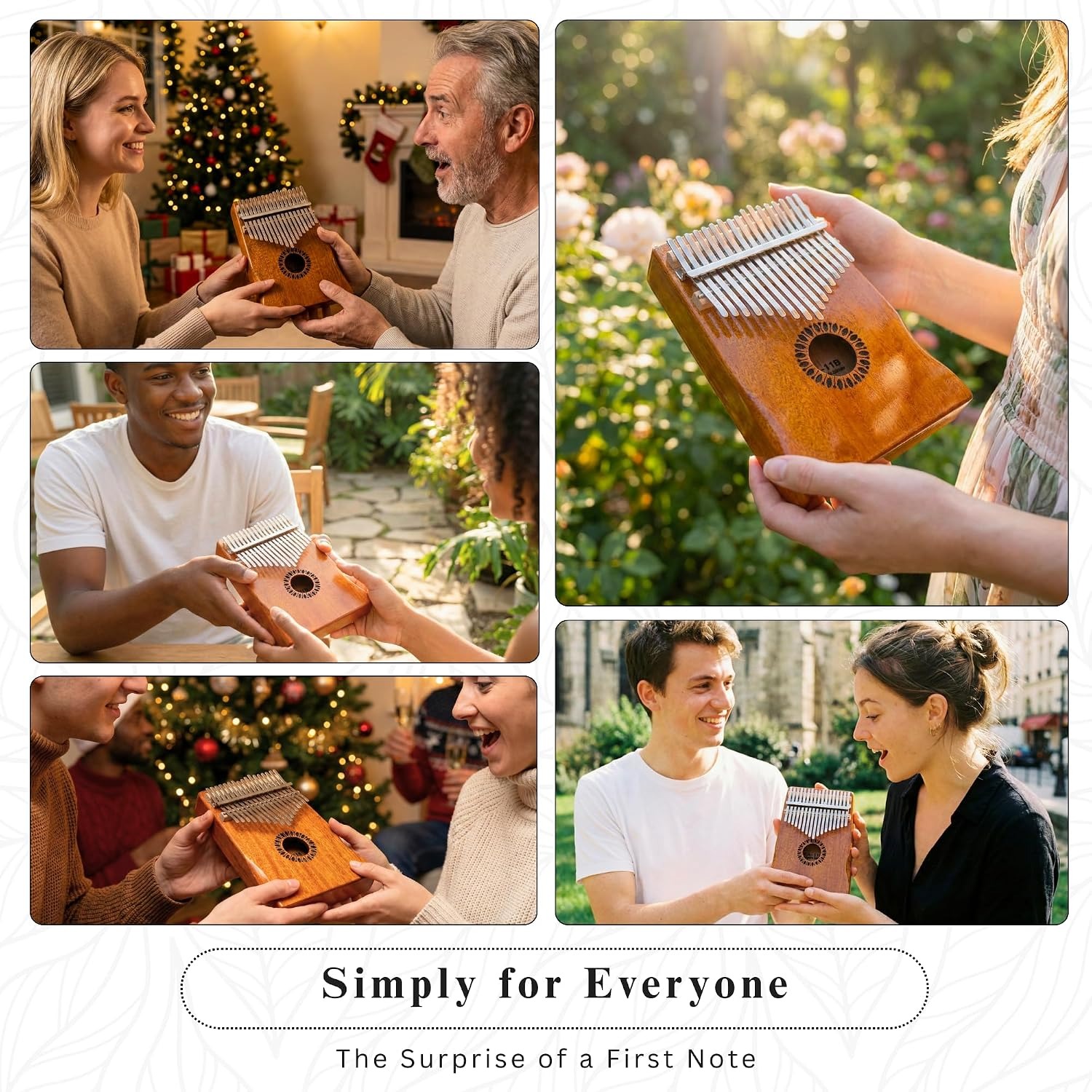
It is one of the easier musical gifts to get right, since the recipient does not need prior experience or extra accessories. The kit with the book and bag means it is ready to open and play, which makes it a solid choice for a best kalimba gift set.

Does it come gift wrapped?

Gift wrapping is not included as standard. The flannelette bag does make the instrument look presentable straight out of the box if you are handing it over in person.

Is there a warranty?

Yes, the manufacturer lists a 180 days warranty on this model. Keep your order confirmation, as you will usually need proof of purchase for any claim.

Where is it made?

The country of origin is listed as China, and the manufacturer is Newlam. Full manufacturer contact details are printed on the packaging.

What colour is it?

The colour is listed as wood. The finish type is described as unfinished, polished, varnished or lacquered, so the exact surface treatment can vary between units.

How does delivery work?

Most orders arrive within 5 to 10 working days of the order date. Rural, remote and northern addresses can take a little longer. Delivery is free on orders of $125 or more and a flat $18 under that, and you get tracking by email once the parcel is on its way.

Can I return it if I change my mind?

Yes. You can return it within 14 days of delivery if you change your mind, as long as it is unused and in its original packaging with everything included. You pay the return postage. Contact us first and we will send the return details.

What if it is not right when it arrives?

Contact us with your order number and a short description of the problem, along with a photo if something is damaged or a tine is bent. We will sort out a replacement, a repair route under the 180 days warranty, or a refund depending on what has gone wrong.

The Buyer's Guide to Choosing a 17 Key Kalimba

6 min read Toy Warehouse

The problem with starting an instrument

Most people who say they are not musical are really saying they gave up early. That usually happens because the first instrument they tried punished them. A guitar makes a buzzing mess until your fingertips toughen up. A violin sounds genuinely awful for months. A keyboard is fine but it takes up a corner of the room and you need to learn two hands at once before anything sounds like a song.

The kalimba is different in one specific way. The first note you pluck sounds good. Not promising, not nearly there, actually good. Every tine is tuned to the same key, so whatever order you hit them in, it works. That removes the discouragement phase entirely, and discouragement is what kills most beginner instruments before week three.

That is the gap a 17 key kalimba fills. It is a real instrument with real depth to it, but the entry step is almost flat.

How a thumb piano actually works

The design is simple and it has been around a long time. A set of metal tines is clamped to a wooden body by a bridge and a bar. The tines stick out at different lengths. A longer tine vibrates slowly and gives a lower note, a shorter one vibrates faster and gives a higher note. You pluck them with your thumbs and the wooden body amplifies the vibration.

The layout surprises people at first. The lowest note sits in the middle and the notes climb outwards, alternating left and right as they get higher. So the scale zigzags from the centre instead of running left to right like a piano. It feels odd for about ten minutes and then it feels natural, because it means your two thumbs share the work evenly rather than one doing everything.

On this model the tines are steel bars and the body is wood. The sound profile is described as ethereal, which is a fair word for it. There is a soft bell quality to the note with a long tail of resonance, and when you play two tines together they ring against each other pleasantly.

One detail worth noticing is that the letters and note numbers are embossed into the keys rather than printed on stickers. Stickers are the standard cheap solution, and they peel. Your thumbs are rubbing those exact spots hundreds of times a session. Stamped markings stay put, and that matters for a kalimba for beginners who still needs to glance down while reading tablature.

Who this suits

Adults who want a hobby away from a screen tend to get the most from it. You can play a kalimba sitting on a sofa with no setup, no cables and no tuning ritual. Fifteen minutes of it is genuinely calming, partly because the instrument is quiet and partly because there is no failure state. People often describe it as the best calming instrument to learn for exactly that reason.

It also works well for children, with a bit of supervision early on. The tines are metal and the tuning hammer is a small part, so very young children should not be left alone with it. But a school-age child can hold it, pluck it, and make something that sounds like music on day one, which is a huge motivator.

Travellers are the third group. At 327 g and roughly 18 cm long it goes in hand luggage without a second thought. If you have ever wanted an instrument on a trip and left the guitar at home, this solves it.

Experienced musicians buy them too. A guitarist writing a melody line often finds the kalimba shakes loose ideas that a fretboard does not, simply because the layout forces a different approach.

How to choose between kalimbas

Key count comes first. Ten and twelve key models exist and they are cute, but the range runs out fast and most published tablature assumes seventeen. Twenty-one key models give you more notes but a wider body that smaller hands find awkward. Seventeen has become the standard because it balances those two things, and if you are buying one kalimba, that is the one to buy.

Next is the body. Solid wood boards give a warmer, longer-ringing note than hollow-box designs, which tend to sound louder but thinner. This Newlam model uses a wood body with a 3 cm depth, which is in the normal range for a flat-board kalimba.

Then look at the tines. Steel is the usual material and it gives a bright, clear attack. What matters more than the alloy is whether the tines are smooth at the plucking end. Rough edges catch on your thumb and get uncomfortable after a few minutes.

Comfort is the thing buyers underestimate. The sides of a kalimba press into your palms the whole time you play. A curved handrest, which this model has, spreads that pressure instead of concentrating it on an edge. If you intend to play for more than ten minutes at a stretch, that shape is not a luxury.

Finally, check what is in the box. A bare instrument means you still need a bag and something to learn from. This one includes the instruction book, a flannelette bag and a cleaning fabric, which covers the basics on arrival.

Living with it day to day

Tuning is the one maintenance task. Kalimba tines are held by friction, so you adjust pitch by tapping a tine deeper into the bridge for a higher note or outwards for a lower one. It sounds alarming and it is not. Tap gently, check with a free tuner app on your phone, repeat. Most owners do this once every few weeks, and more often if the instrument has been through a big temperature change.

Cleaning is simpler still. Thumbs leave oil on steel, and oil dulls both the look and the tone over time. A wipe with the supplied cloth after playing handles it. Do not use kitchen sprays on the wood, and never run it under a tap.

Storage matters more than people think. Wood moves with humidity, and a kalimba left on a sunny windowsill through a summer will drift out of tune and may develop a finish issue. The bag exists for a reason. Use it, and keep the instrument somewhere with stable room temperature.

Technique-wise, the main habit to build early is alternating thumbs rather than favouring one. It feels clumsy for the first week and then it opens speed you cannot get any other way. Many players also use thumb picks or finger covers once they start playing harder, which protects nails on long sessions.

The short version

A 17 key kalimba is the rare instrument where the first five minutes are enjoyable rather than frustrating. This Newlam model covers the practical points that actually matter, with a wood body, 17 steel tines, note markings stamped into the keys instead of stuck on, and a curved handrest that keeps your palms happy. At 327 g it travels anywhere, and the included book, bag and cleaning cloth mean there is nothing else to buy before you start.

If you want a quiet, portable instrument that sounds lovely from the first note and does not demand months of groundwork, this is a sensible place to begin.

Browse the shop

Not sure if a kalimba suits you?

Send us a quick message about who it is for and how they plan to use it, and we will tell you honestly whether this is the right starting instrument.

Ask us a question

Page summary

The Newlam 17 Key Kalimba (model CA-17B) is a wooden thumb piano with 17 steel tines and an ethereal sound profile. Letters and note numbers are embossed directly on the keys, and the handrest is curved for comfort during longer playing sessions. It measures 17.98 x 12.9 x 3 cm and weighs 327 g, making it easy to carry. The box includes an instruction book, a flannelette bag and a cleaning fabric. It suits left or right hand orientation and is made in China. A 180 days warranty applies. Tuning key, colour, and specific wood species are not specified by the maker. Suitable for beginners, children with supervision, and experienced players who want a compact instrument.