

The complete guide
Buying A Unicorn Window Art Kit - What To Know Before You Choose
The craft kit problem most parents know too well
You buy a craft set, the child spends twenty minutes on it, and then it sits in a cupboard with half the pieces missing and one paint pot dried solid. The gap between "looks fun on the box" and "actually gets used twice" is where most money disappears.
A window art kit sidesteps a lot of that for one simple reason. The result does not get filed away. It goes on the glass, and it stays visible every single day. A child walks past their own work on the way to breakfast and sees the morning sun pushing light through it. That feedback loop is far stronger than a drawing in a folder, and it is why this style of craft tends to get revisited rather than abandoned.
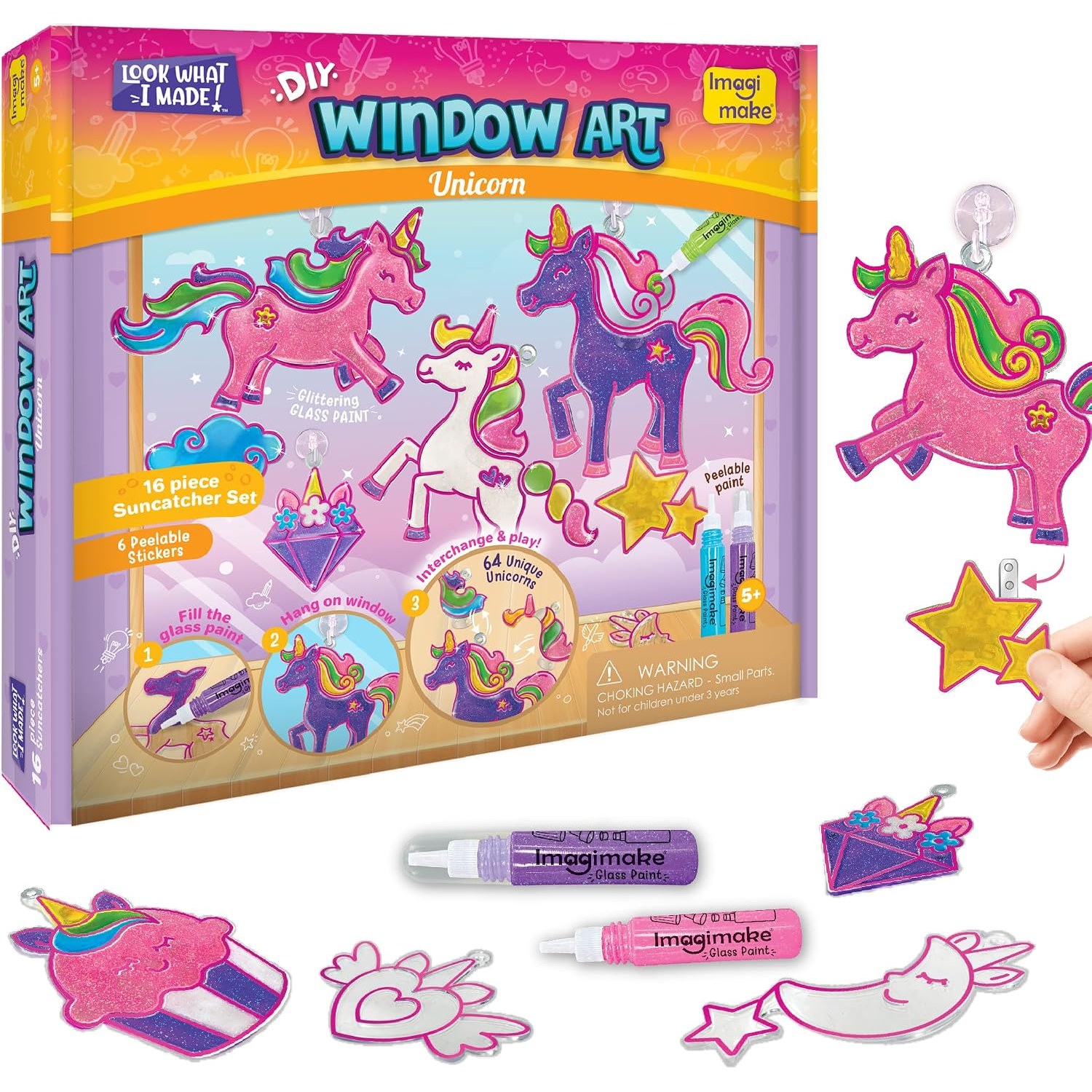
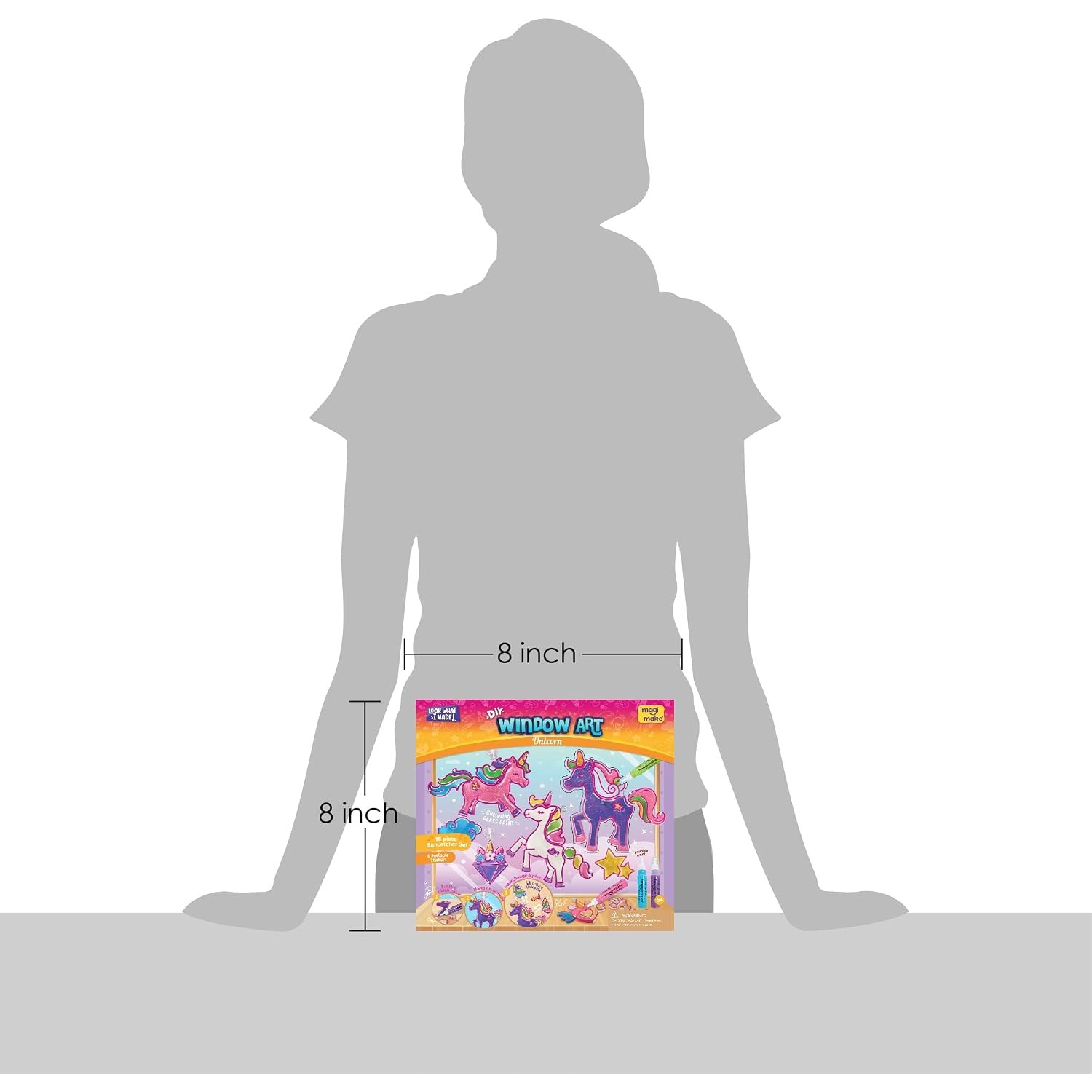
This particular set is the Imagimake Unicorn Window Art Kit, model WA03, with 52 pieces in a 31 x 28 x 5.5 cm box weighing 340 g. Below is what it actually does, who it suits, and how to get good results from the first session.
How window art actually works
The method borrows from stained glass, simplified down to something a child can manage at a kitchen table.
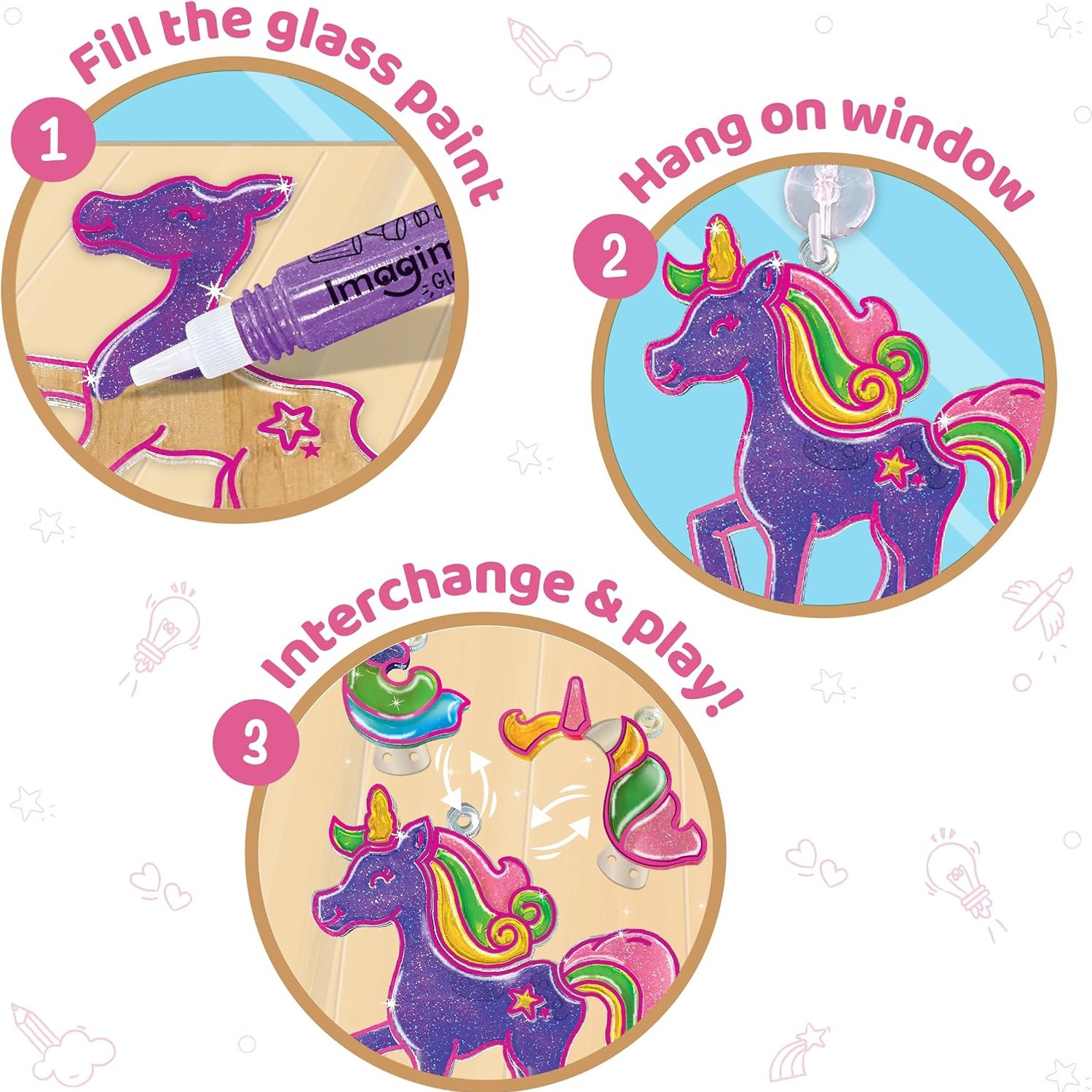
There is a design book with printed outlines. A clear acetate sheet lays over the top of a chosen design. The child traces the outline with the included liner, which lays down a dark border. That border does two jobs. It stops the colours running into each other, and it gives the finished piece enough structure to hold together.
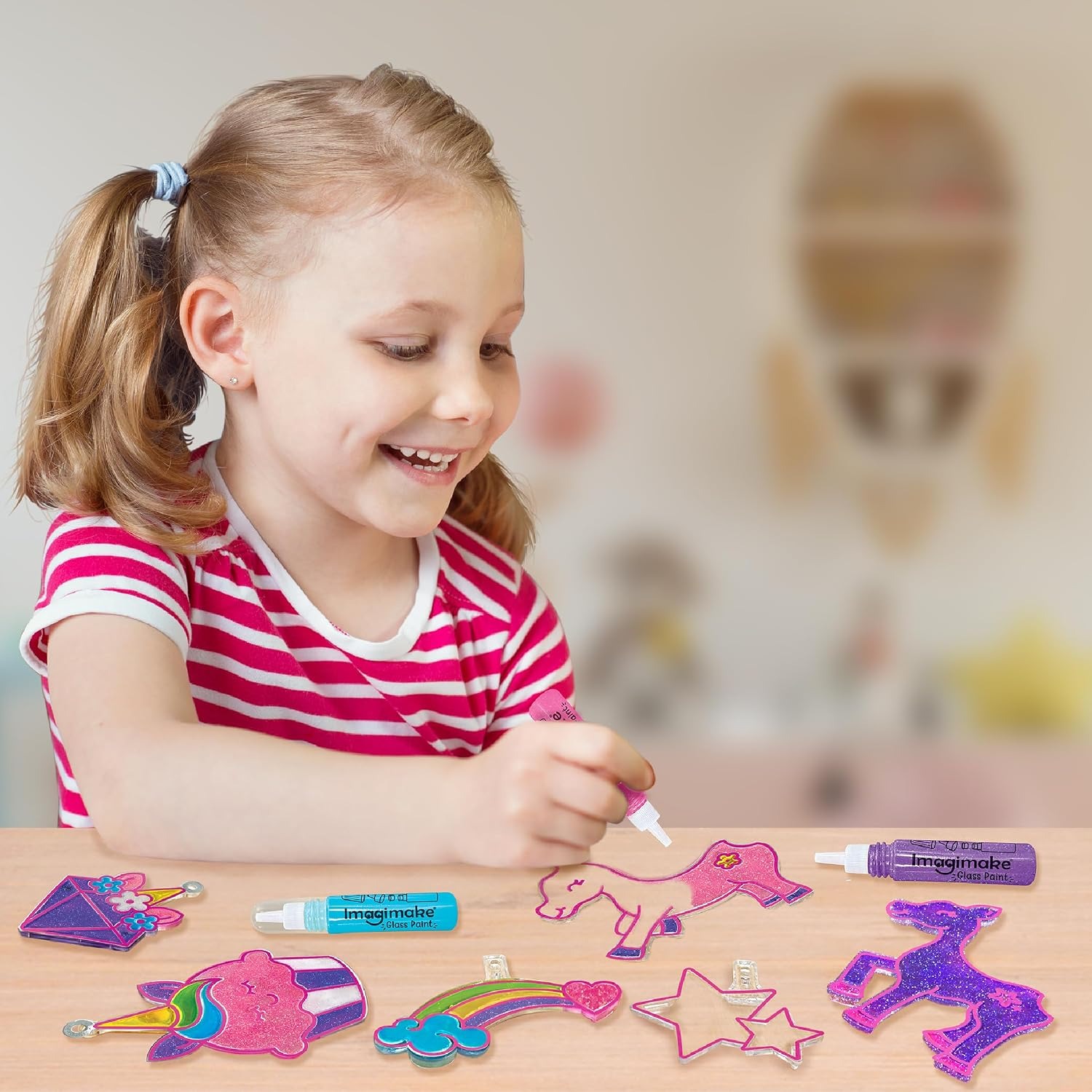
Next comes the fill. Eleven peel-off glass paint tubes supply the colour, and five of those are glitter paints at 5 ml each. The paint gets squeezed inside the traced outline until it meets the line all the way round. Thin, even coverage works better than thick lumps, though most kids learn that the hard way on their first attempt.
Then comes the wait. The paint has to dry fully. When it has, the whole design peels off the acetate in one piece, like a sticker, and presses onto a window. The acetate wipes clean and gets used again.
That is the entire loop. Trace, fill, dry, peel, stick. It is repeatable, it needs no water or brushes, and nothing in it requires an adult to drive the process once a child has done it once.
What makes this set different from a single-picture kit
Most window art kits give you a fixed set of designs. Paint them, stick them, done.
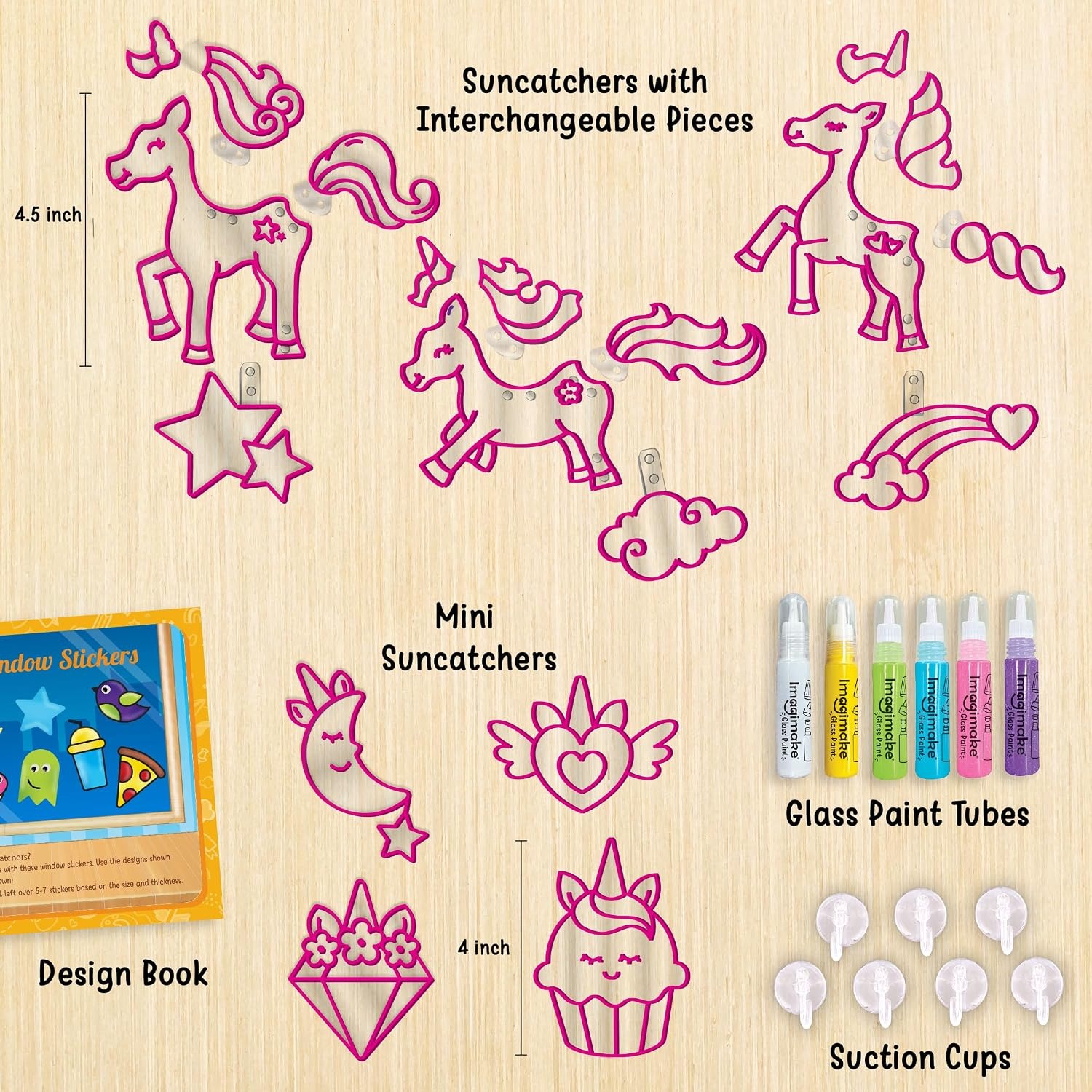
This one is built around interchangeable parts. There are 12 pieces that make up three unicorns, and those pieces (bodies, manes, tails) swap between each other. Add the rainbow clouds and stars and a child can keep rearranging the scene long after the painting is finished. A unicorn with a pink mane one week becomes a unicorn with a blue mane the next, and that is a five second change rather than a whole new project.
The 4 mini suncatchers work on a different timescale again. The moon, the winged heart, the diamond and the cupcake are small, which means less paint and faster drying. They are the right choice when there is forty minutes before dinner, or when a younger sibling wants to join in without committing to a full unicorn.
Seven suction cups come in the box. That sounds like a small detail until you have finished a craft project with a child and realized you have nothing to hang it with.
Who this suits
The age range is listed as kids, and in practice this lands squarely with primary school ages. The key abilities are tracing a line reasonably steadily and squeezing a tube with some control. A child who can colour inside the lines will manage this.
Younger children can absolutely take part, with an adult handling the liner outline. That split works well. The grown-up does the fiddly bit, the child does the satisfying bit, and both end up invested in where it hangs. Plenty of families find this is the version that actually gets done.
It is sold under a unicorn theme and listed in a girls department, but the activity itself has no gender to it. Any child who likes painting and likes glitter will get on with it.
As a gift, it has a couple of practical advantages. It is light at 340 g, the box is flat and easy to wrap, and it is a complete project with nothing else to buy. A child can open it and start within ten minutes, which matters on a birthday morning when attention spans are short.
Getting good results on the first try
A few things make the difference between a design that peels off cleanly and one that tears.
Close the outline completely. Any gap in the traced border is a place where the paint can escape and where the dried design will split. Go round the shape twice if the first pass looks patchy.
Do not rush the drying. This is the single most common cause of disappointment. Paint that feels dry on top can still be soft underneath, especially where it was applied thickly. Leaving a design overnight on a flat surface costs nothing and saves a tantrum.
Keep the paint even. Squeeze a steady bead rather than a puddle. Thick areas take much longer to set and tend to stay slightly tacky, which makes peeling messy.
Clean the glass first. A quick wipe with a damp cloth removes the dust and fingerprints that stop both the dried designs and the suction cups from gripping. This takes ten seconds and prevents the annoying business of pieces sliding down the pane.
Put the caps back on. Glass paint in a 5 ml tube does not survive being left open overnight. Capping tubes straight after use is the single habit that keeps the kit usable for months.
Where to hang the finished work
Pick a window that gets direct sun for part of the day. The glitter paints only really earn their keep when light passes through them, and a north-facing window in permanent shade will make the colours look flat and dull.
Beyond that, any smooth clean glass works. Mirrors, glass doors, shower screens, even a glass-fronted cabinet. Just avoid doors that get slammed regularly, because the vibration will eventually shake pieces loose.
Think about height as well. Hanging the scene at the child's eye level rather than an adult's makes it theirs. They will rearrange it more often if they can reach it.
Looking after the kit
Storage is simple. Caps on tubes, acetate sheet laid flat so it does not crease, everything back in the box. Keep it somewhere cool and out of strong sunlight, because heat is what dries paint in the tube.
Suction cups lose grip when they pick up dust or grease. Wash them in warm soapy water, rinse, dry, and they come back to life. Do the same with the window and the problem usually disappears.
Dried designs on the glass can be wiped gently with a soft dry cloth if they get dusty. If you want to move one, peel from a thick corner rather than a thin point, and go slowly.
Hands get washed after painting, as with any craft paint.
The short version
If you want a craft kit that does not get finished and forgotten in one afternoon, the window format is a sensible bet. The work ends up on display, it catches the light, and it changes as the day moves.
This set gives you 52 pieces, 11 peel-off glass paint tubes with 5 glitter shades, 12 interchangeable parts across three unicorns, rainbow clouds and stars, 4 mini suncatchers, a liner, 7 suction cups, a design book and a reusable acetate sheet. Everything needed is in the box. Nothing else to buy.
The method is easy enough for a child to repeat alone after one guided run-through, and the swappable unicorn parts mean the scene can change whenever the mood does. Trace carefully, let it dry properly, and hang it where the sun hits. That is really all there is to it.