
The complete guide
Choosing a Stunt RC Car for Kids: A Practical Buyer's Guide
The problem with most first remote control cars
Watch a six year old with a basic RC car for ten minutes and you will see the same pattern. They drive it fast, it hits a chair leg, it tips onto its roof, and it sits there spinning its wheels. The child walks over, turns it back the right way up, drives for another twenty seconds, and it happens again. By the fourth trip across the room, the toy is on the floor and the child is doing something else.
That is not a child with a short attention span. That is a design problem. A small car with a high centre of gravity and a lot of torque is always going to end up on its back. The fix is simple once you see it, which is to build the car so it does not care which way up it lands.
How a double sided stunt car works
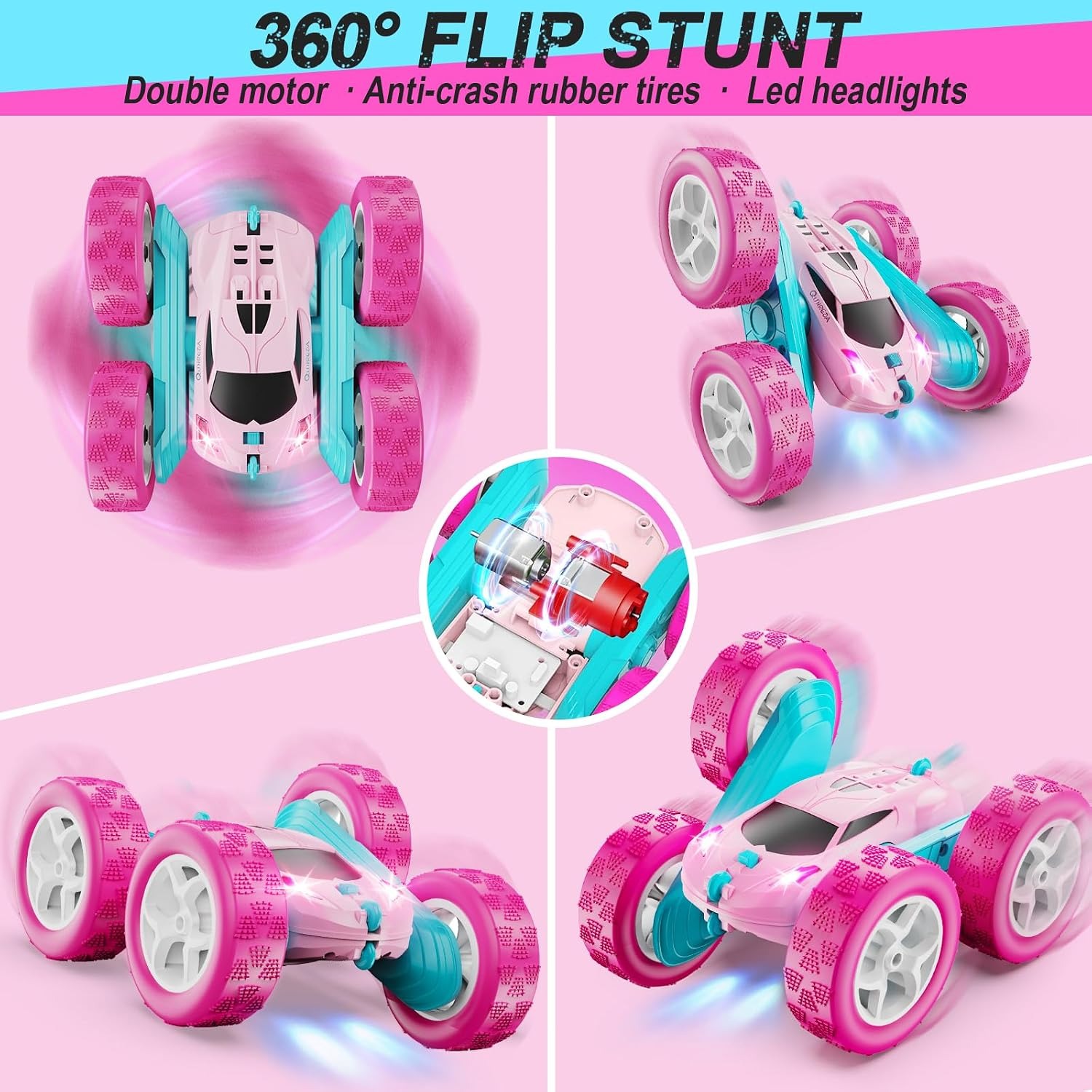
A double sided stunt car has a symmetrical body and oversized wheels that stick out past the shell on both faces. Flip it over and the wheels still touch the ground, so the motors drive it just the same. The direction of travel reverses relative to the shell, which takes a few seconds to get used to, but children adapt to that almost immediately.
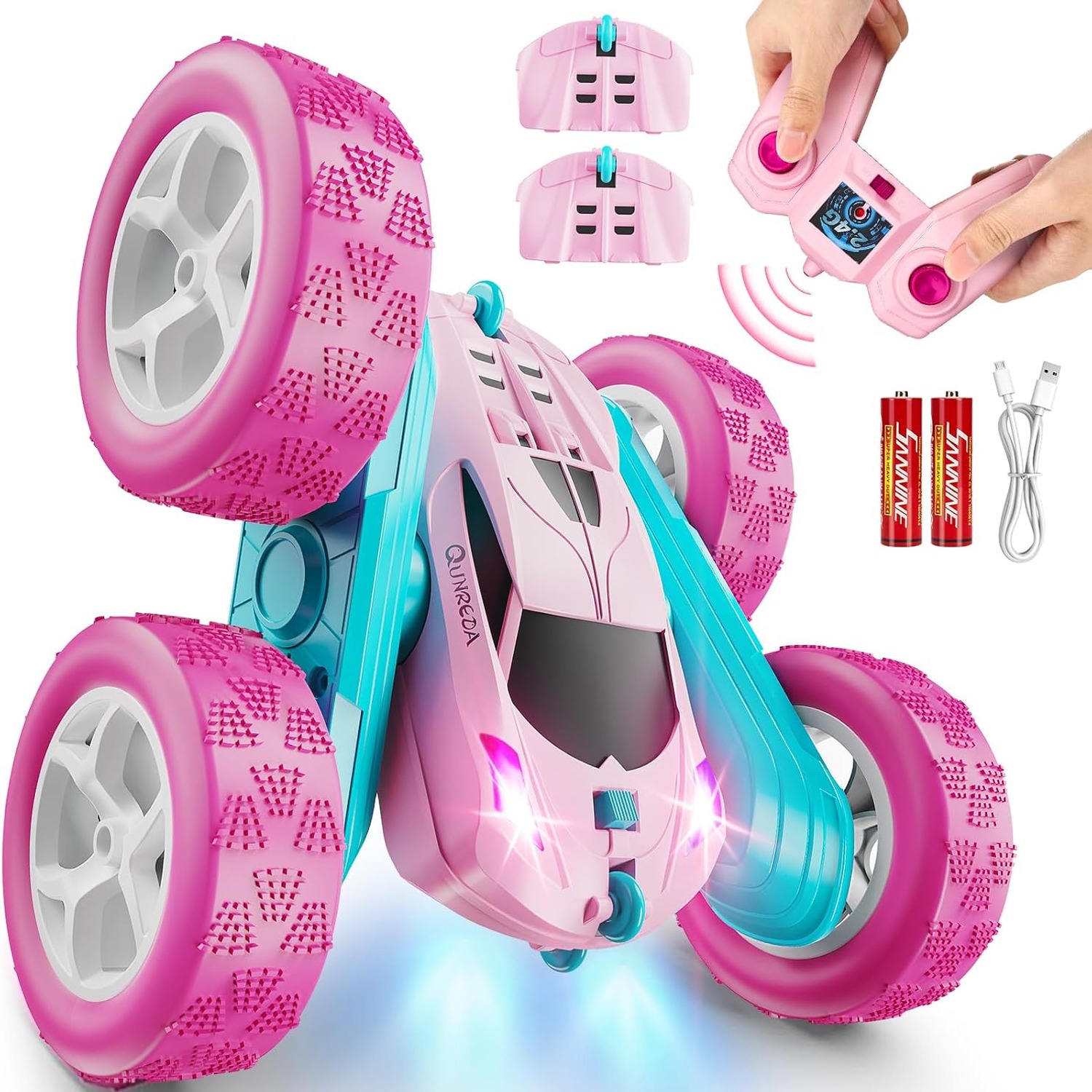
This pink RC stunt car uses that layout. The red LED headlights in the nose help, because after a spin or a roll they tell you at a glance which end is pointing where. It is a small detail that saves a lot of confusion during a fast game.
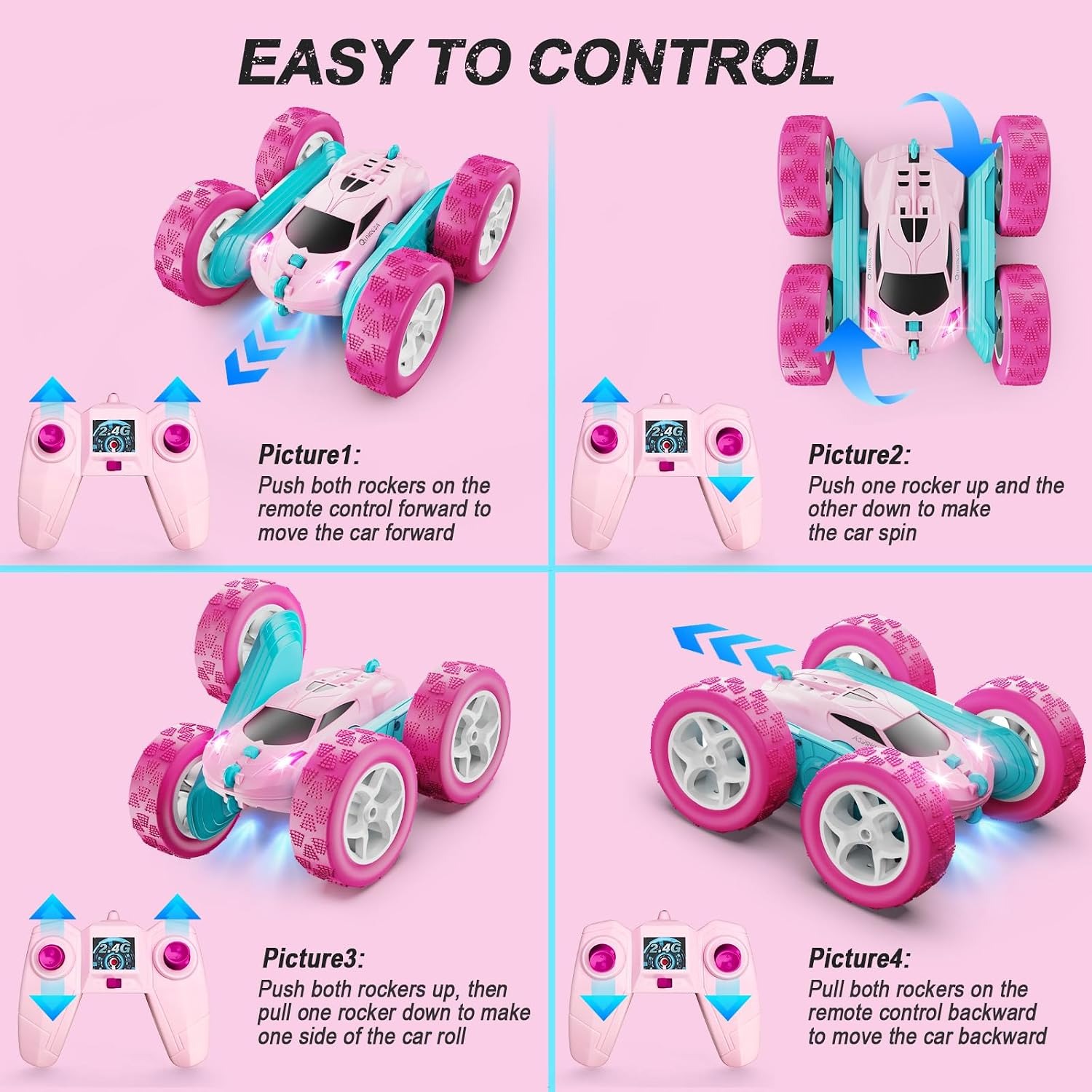
The same geometry that makes it roll-proof also makes stunts easy. Because the wheels are large relative to the body, a burst of power can tip the car up and over deliberately. The manual sets out a sequence of moves, from straightforward driving through clockwise and anticlockwise spins to 360 degree rotations and tumbling flips. The handset keeps things to a short set of buttons rather than full analogue sticks, which is exactly what a beginner needs. There is nothing to master before the first bit of fun happens.
The battery question, and why modules matter
Run time is where cheap RC cars disappoint. A sealed internal pack gives you a short burst of play, then the car is out of action for an hour or two while it charges, usually plugged into a wall where it is in everyone's way.
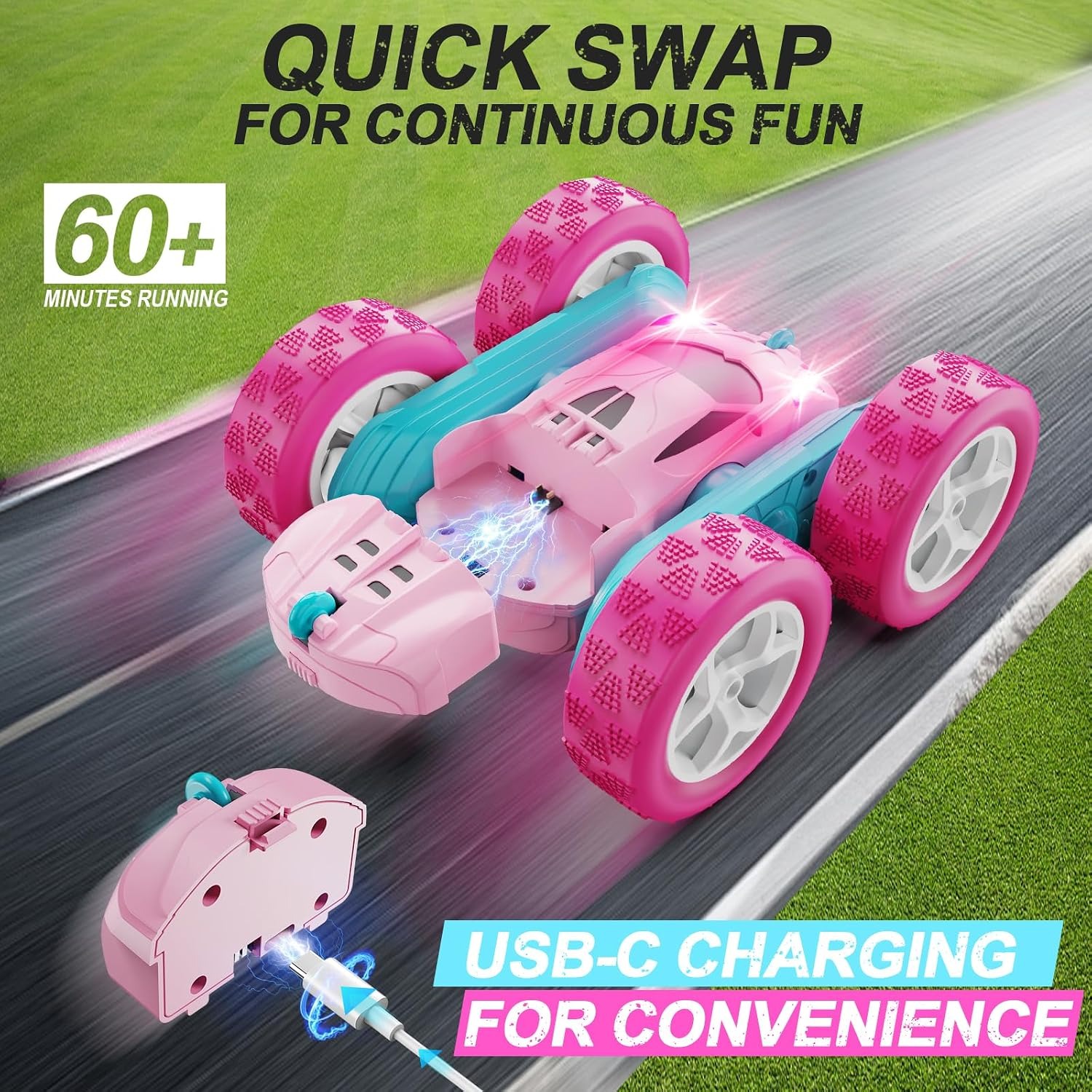
This one uses detachable battery modules instead. One lives in the car, the other comes in the box as a spare. When the first runs flat, pull it out, drop the spare in and keep driving while the first one charges from the supplied cable. The modules sit inside ABS shells, so a child is handling a plastic block rather than bare cells.
The exact run time per charge is not specified by the maker, so we are not going to put a number on it. What we can say is that having two modules roughly doubles whatever the single-pack figure is, and it removes the dead time in the middle of a play session. For a birthday afternoon or a long car trip, that matters more than a headline minutes figure.
Radio, range and racing
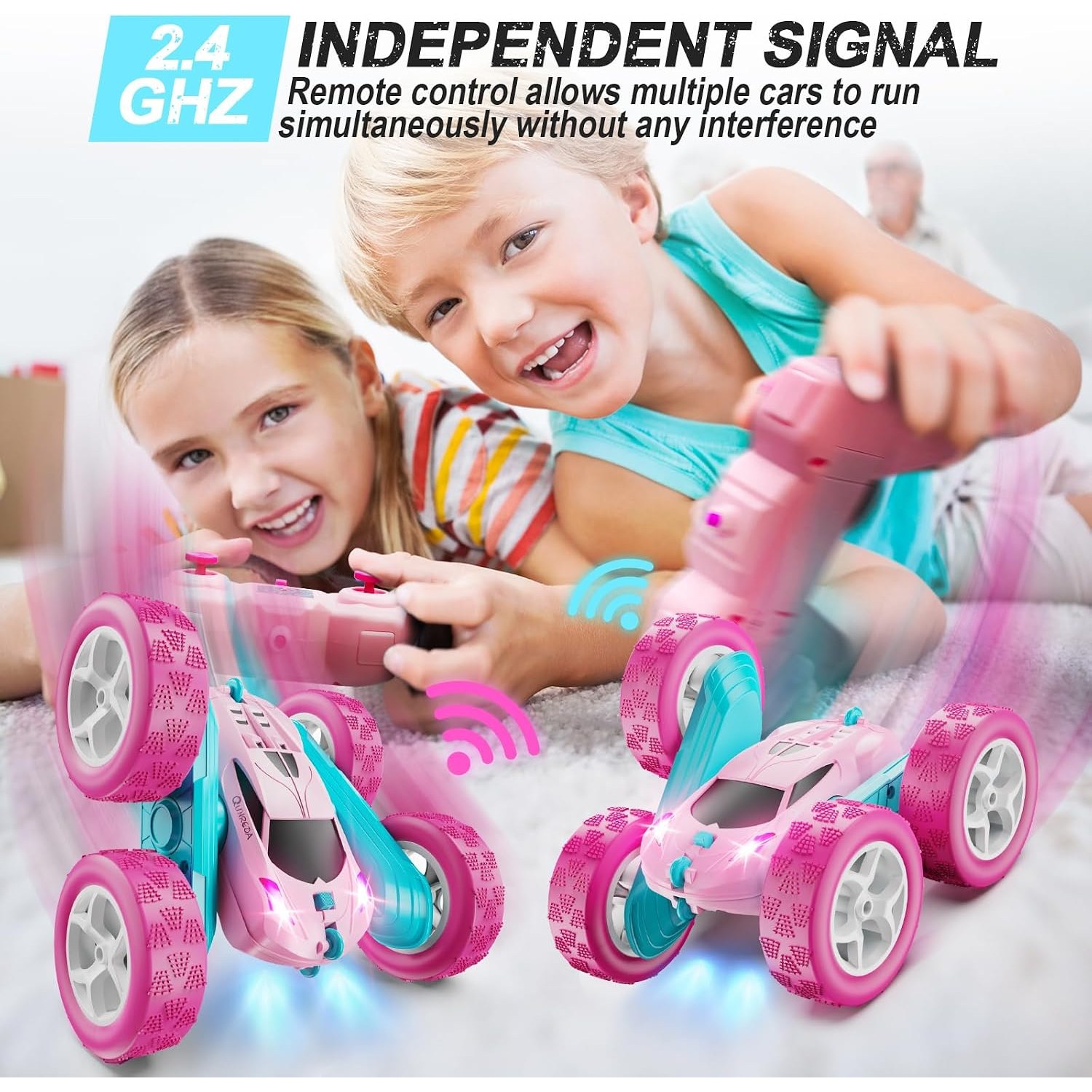
The handset runs on 2.4GHz with anti-interference. In plain terms, that means two or more of these cars can run in the same room without one child's controller hijacking another child's car. If you are buying a pair for siblings, or if the car is going to a party, this is the feature that keeps the peace.
Stated control range is up to 50 metres. That is a generous figure on open ground, such as a lawn or a long driveway. Indoors, walls and large metal appliances will cut it back, though in a normal house you will run out of floor long before you run out of signal.
Listed top speed is 10 kilometres per hour. For context, that is a brisk jog. Fast enough that a hallway run feels genuinely exciting, slow enough that a beginner has a chance of steering around the dog.
Who it suits
The manufacturer recommended age is 6 years. That lines up with what the car asks of a child, which is enough hand-eye coordination to anticipate where a moving object will be in a second's time, and enough patience to learn that the controls reverse when the car flips.
It suits a child who likes action more than realism. If your kid wants a scale model of a particular rally car with working suspension and a hobby grade radio, this is not that, and those cost several times more. If they want something that crashes, flips, spins and keeps going, this is squarely in the right category. It is also a sensible pick if you want the best rechargeable rc car for a child who loses interest in anything that needs a pack of AAs every weekend.
Pink is the colour here. That is cosmetic and nothing else, the mechanics are the same across colourways, but it is the reason a lot of people searching for a pink remote control car end up on this page.
Where it can be driven
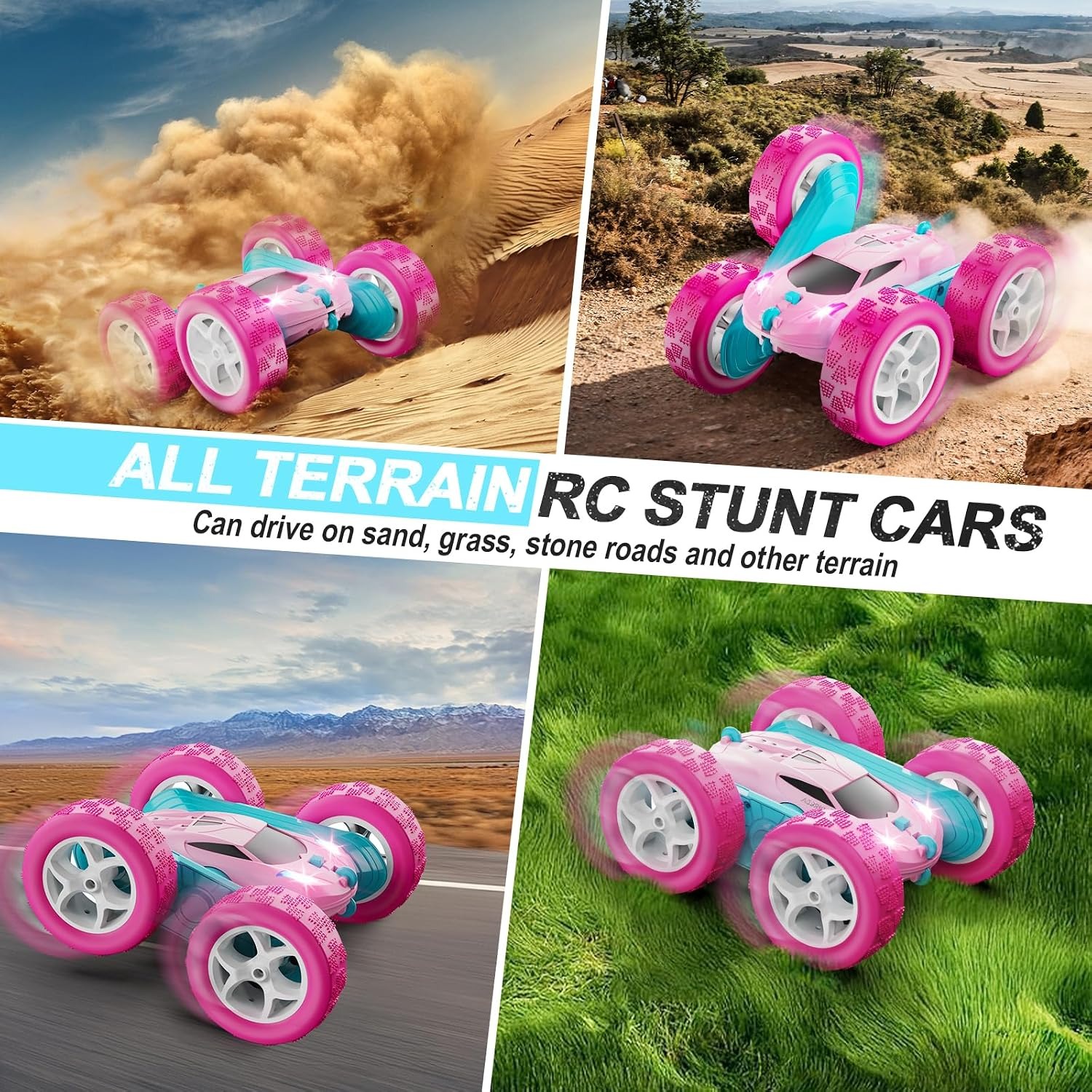
The tires are moulded from a softer grade of ABS. They flex on impact, which takes some of the shock out of a hard landing, and they grip well on smooth surfaces. Practically, that means it works on tiles, floorboards and low pile carpet indoors, and on grass, packed dirt and sand outside.
A few places to avoid. Deep mud and loose gravel can wedge in around the axles and stop the wheels turning. Thick shag carpet soaks up the power and makes flips difficult. And since no waterproof rating is given, keep it clear of puddles, pools and wet sand. Damp grass is fine as long as you dry the car off afterwards.
Looking after it
Care here is not complicated. After an outdoor run, wipe the shell and tires with a dry or barely damp cloth, then let it dry fully before you put a battery module back in to charge. Pick out any grit from around the wheels so the axles stay free.
Charge only with the supplied cable, and unplug the module once it is done rather than leaving it connected for days. If the car is going into storage for a few months, take the AA batteries out of the remote. Leaking alkaline cells are the most common way a working handset becomes a dead one.
Keep it indoors between sessions. Heat and direct sun are hard on plastics and on lithium cells alike.
What is in the box
The package covers everything needed for the first run. You get the car, the remote, two rechargeable battery modules, two AA batteries for the handset, a charging cable, a small screwdriver for the battery compartment and the user manual. Nothing needs assembling.
That completeness is worth noting if this is a gift. There is no stage where the wrapping comes off on a birthday morning and somebody has to go hunting for batteries.
How to choose between stunt cars
If you are comparing a few options, there are four things actually worth checking. First, is the car genuinely double sided, or does it just do one flip trick and then need rescuing. Second, how many battery packs come in the box, because one is a short afternoon and two is a proper one. Third, is the radio 2.4GHz, which matters the moment there is more than one car in the room. Fourth, what is the recommended age, since a car that is too fast for its driver ends up at the back of the cupboard.
Price is the obvious fifth factor, but it is the least useful one on its own. A cheaper car with a sealed battery and a single flip trick costs more in abandoned play time than it saves at checkout.
The short version
This is a pink, double sided stunt car for children aged 6 and up. It drives upside down, spins, flips and rotates, runs at up to 10 km/h, and is controlled by a simple two button 2.4GHz handset with a stated range of 50 metres. Two detachable rechargeable battery modules mean one charges while the other drives. The ABS body and soft tires handle floors, grass, dirt and sand. Everything needed is included, so it works straight out of the box.
If you want a first RC car that survives being crashed by a learner, this design removes the single biggest reason these toys get abandoned.